Browse · MathNet
PrintSaudi Arabia Mathematical Competitions 2012
Saudi Arabia 2012 geometry
Problem
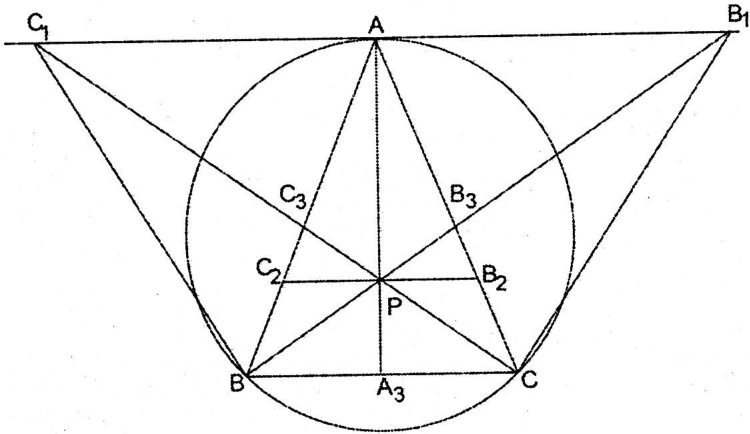
Triangle is inscribed in circle . Line is tangent to at . Points and lie on such that rays and bisect and , respectively. Segments and intersect at . The line through parallel to segment intersects sides and at and , respectively. Prove that if is the midpoint of then is isosceles.
Solution
Assume that is the midpoint of segment ; that is, . We will show that .
Set , , and . Extend segment through to meet segment at . Then it is clear is the midpoint of side or . Let denote the intersections of pairs of segments and , and , respectively. By Ceva's theorem, we have
Note that is equal to the ratio between the areas of triangle and ; that is, Because line is tangent to , . Hence and Because line is tangent to , we also have . Thus, triangle is similar to triangle . By the Law of sines, we have It follows that In exactly the same way, we can show that It follows that or Because we can have at most one of and being negative, we must have both of them positive, from which it follows that and are acute angles. For , both and are monotonically increasing, thus we must have , as desired.
Set , , and . Extend segment through to meet segment at . Then it is clear is the midpoint of side or . Let denote the intersections of pairs of segments and , and , respectively. By Ceva's theorem, we have
Note that is equal to the ratio between the areas of triangle and ; that is, Because line is tangent to , . Hence and Because line is tangent to , we also have . Thus, triangle is similar to triangle . By the Law of sines, we have It follows that In exactly the same way, we can show that It follows that or Because we can have at most one of and being negative, we must have both of them positive, from which it follows that and are acute angles. For , both and are monotonically increasing, thus we must have , as desired.
Techniques
Ceva's theoremTangentsHomothetyTriangle trigonometryAngle chasing