Browse · MATH
Printjmc
geometry intermediate
Problem
Six small circles, each of radius units, are tangent to a large circle as shown. Each small circle also is tangent to its two neighboring small circles. What is the diameter of the large circle in units? 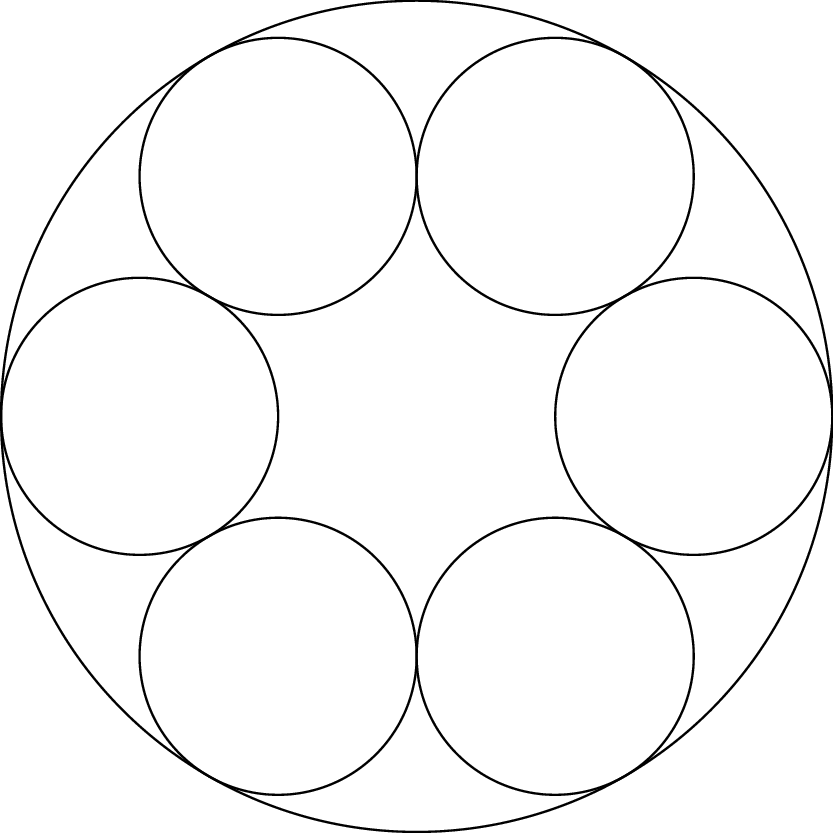
Solution
We can draw two similar hexagons, an outer one for which the large circle is the circumcircle and an inner one that connects the centers of the smaller circles. We know that the sidelength of the inner hexagon is 6 since consists of the radii of two small circles. We also know that the radius of the outer hexagon is 3 units longer than the radius of the inner hexagon since is the radius of a small circle. There are now several approaches to solving the problem.
We use a 30-60-90 triangle to find the radius of the inner hexagon. Triangle is an isosceles triangle since and are both radii of a regular hexagon. So dropping a perpendicular from to bisects and and creates two congruent right triangles. The central angle of a hexagon has a measure of . So . Each right triangle has a leg of length and is a 30-60-90 right triangle (since was bisected into two angles of ). That makes the length of the hypotenuse (the radius of the inner hexagon) two times the length of the short leg, or . Now we know that the radius of the outer hexagon is , so the diameter is units long.
We prove that the triangles formed by the center to two vertices of a regular hexagon (such as and ) are equilateral triangles. The central angle of a hexagon has a measure of . So . The interior angle of a hexagon has a measure of . That means the other two angles in the triangle each have a measure of half the interior angle, or . All three angles equal so the triangle is an equilateral triangle. Then we know that . Now we know that the radius of the outer hexagon is , so the diameter is units long.
Another way to prove that the triangles are equilateral is to show that triangle is an isosceles triangle and (see other approaches for how). That means and . Then all three angles have a measure of each. We continue the rest of approach 2 after proving that triangle is equilateral.
We use a 30-60-90 triangle to find the radius of the inner hexagon. Triangle is an isosceles triangle since and are both radii of a regular hexagon. So dropping a perpendicular from to bisects and and creates two congruent right triangles. The central angle of a hexagon has a measure of . So . Each right triangle has a leg of length and is a 30-60-90 right triangle (since was bisected into two angles of ). That makes the length of the hypotenuse (the radius of the inner hexagon) two times the length of the short leg, or . Now we know that the radius of the outer hexagon is , so the diameter is units long.
We prove that the triangles formed by the center to two vertices of a regular hexagon (such as and ) are equilateral triangles. The central angle of a hexagon has a measure of . So . The interior angle of a hexagon has a measure of . That means the other two angles in the triangle each have a measure of half the interior angle, or . All three angles equal so the triangle is an equilateral triangle. Then we know that . Now we know that the radius of the outer hexagon is , so the diameter is units long.
Another way to prove that the triangles are equilateral is to show that triangle is an isosceles triangle and (see other approaches for how). That means and . Then all three angles have a measure of each. We continue the rest of approach 2 after proving that triangle is equilateral.
Final answer
18