Browse · MathNet
Print58th Ukrainian National Mathematical Olympiad
Ukraine geometry
Problem
Consider a triangle ABC and a line that does not coincide with the triangle sides and passes through the point A. This line meets altitudes and at the points and , respectively. By and we denote points that are symmetrical to and with respect to the sides AB and AC, respectively. Prove that the circumcircle of the triangle is tangent to the circumcircle of the triangle .
(Myhailo Plotnikov)
(Myhailo Plotnikov)
Solution
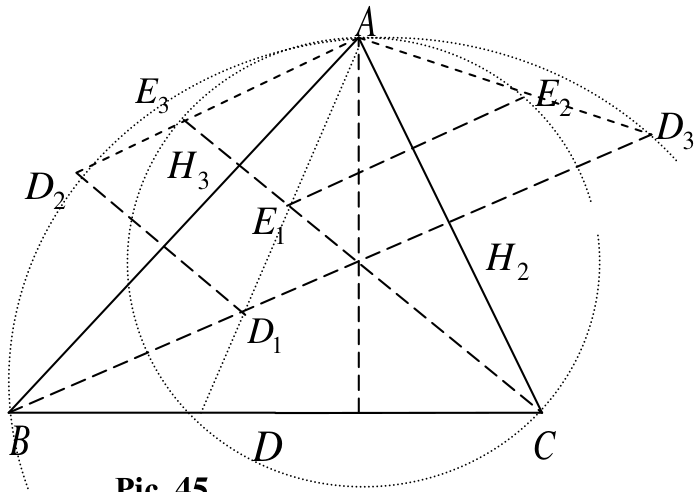
By we denote points that are symmetrical to with respect to AB and AC, respectively (Fig. 45). It follows from symmetry that , and CA is a bisector of an angle that is created by the lines and . Then we have
Thus points A, , and C are cyclic. In the same way points A, , and B are cyclic. Then the circumcircle of the triangle coincides with the circumcircle of . In the same way, the circumcircle of coincides with the circumcircle of . Since and are symmetrical to the same line with respect to AB, then points A, , are collinear. In the same way, A, , are collinear. Moreover, Thus , and their circumcircles are tangent to each other, because under homothety one of the circles maps to the other circle and they have a common point A.
Pic. 45
Thus points A, , and C are cyclic. In the same way points A, , and B are cyclic. Then the circumcircle of the triangle coincides with the circumcircle of . In the same way, the circumcircle of coincides with the circumcircle of . Since and are symmetrical to the same line with respect to AB, then points A, , are collinear. In the same way, A, , are collinear. Moreover, Thus , and their circumcircles are tangent to each other, because under homothety one of the circles maps to the other circle and they have a common point A.
Pic. 45
Techniques
TangentsHomothetyCyclic quadrilateralsAngle chasingTriangle centers: centroid, incenter, circumcenter, orthocenter, Euler line, nine-point circle