Browse · MathNet
PrintChina Mathematical Competition (Extra Test)
China geometry
Problem
Suppose an ellipse with points and as the foci intercepts side of at (). Taking an arbitrary point on the extending line of , draw arc with , as the center and radius respectively, intercepting the extending line of at . Draw arc with , as the center and radius respectively,
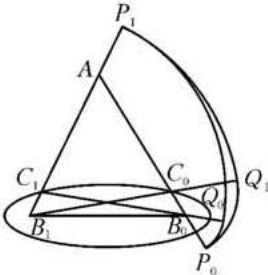
intercepting the extending line of at . Draw arc with , as the center and radius respectively, intercepting the extending line of at . Draw arc with , as the center and radius respectively, intercepting the extending line of at . Prove that
(1) and are coincident, and arcs and are tangent to each other at .
(2) Points are concyclic.
intercepting the extending line of at . Draw arc with , as the center and radius respectively, intercepting the extending line of at . Draw arc with , as the center and radius respectively, intercepting the extending line of at . Prove that
(1) and are coincident, and arcs and are tangent to each other at .
(2) Points are concyclic.
Solution
(1) From the properties of an ellipse we know Also, it is obvious that Adding these equations, we get . Therefore and are coincident. Furthermore, as , (the center of ) and (the center of ) are lying on the same line, we know that and are tangent at .
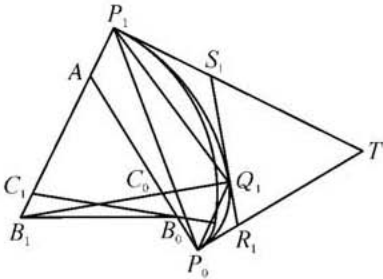
(2) We have thus and , and , and , and are tangent at points respectively. Now we draw common tangent lines and through and respectively, and suppose the two lines meet at point . Also, we draw a common
tangent line through , and suppose it intercepts and at point and respectively. Drawing segments and , we get isosceles triangles and respectively. Then we have Since we obtain In the same way, we can prove that It implies that points are concyclic.
(2) We have thus and , and , and , and are tangent at points respectively. Now we draw common tangent lines and through and respectively, and suppose the two lines meet at point . Also, we draw a common
tangent line through , and suppose it intercepts and at point and respectively. Drawing segments and , we get isosceles triangles and respectively. Then we have Since we obtain In the same way, we can prove that It implies that points are concyclic.
Techniques
TangentsAngle chasingConstructions and loci