Browse · MathNet
Print62nd Ukrainian National Mathematical Olympiad
Ukraine geometry
Problem
We will call a circle without boundary, i.e., a circle without the points on its circumference, a "hedgehog". The diameter of the hedgehog is the diameter of this circle. We will say that the hedgehog "sits" at a point where the center of the corresponding circle is located. Let us consider a triangle with sides , and hedgehogs sitting at its vertices. It is known that there exists a point inside the triangle from which one can reach any side of the triangle along a straight trajectory without touching any of the hedgehogs. What is the largest possible sum of the diameters of these hedgehogs? (Oleksii Masalitin)
Solution
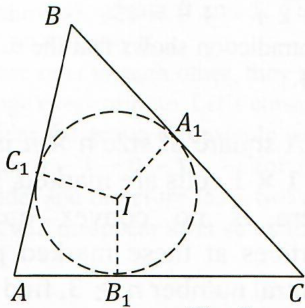
Let us denote the width of the triangle as , and the diameters of the hedgehogs as , respectively. Then suppose . This means that any point on the side of the triangle is inside one of the hedgehogs, and therefore it is impossible to reach this side. Then we have , and similarly and , which implies that . We will prove that there exists an example where equality is achieved in this inequality. Let be the center of the inscribed circle of the triangle and let be its points of tangency to the sides of the triangle (Fig. 5). Then it suffices to consider the hedgehogs sitting at the vertices and whose corresponding circles have radii , , and . Since , , and , this means that are tangents to the hedgehogs sitting at the corresponding vertices, and therefore they will not touch any hedgehogs, which is what we wanted to prove.
Fig. 5
Fig. 5
Final answer
a + b + c
Techniques
Triangle centers: centroid, incenter, circumcenter, orthocenter, Euler line, nine-point circleOptimization in geometryTangents