Browse · MathNet
PrintBaltic Way 2019
Baltic Way 2019 geometry
Problem
Let , and consider a non-intersecting -gon in the plane. Suppose that, to each , there is a unique other vertex among that lies closest to it. The polygon is said to be hostile if for all (counting cyclically).
a. Prove that there exist no convex hostile polygons.
b. Determine all for which there exists a concave hostile -gon.
a. Prove that there exist no convex hostile polygons.
b. Determine all for which there exists a concave hostile -gon.
Solution
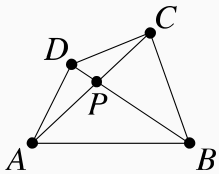
(a) As an auxiliary result, we prove the following. There is no convex quadrilateral in which is the closest neighbour of , and is the closest neighbour of . See Figure below: Convex quadrilateral. Indeed, the diagonals and cross at a point by convexity. The Triangle Inequality yields Since by the first assumption, we must have , contradicting the second assumption.
Now, consider a convex hostile polygon . We say a vertex has separation when its closest neighbour is . Among all vertices, select one with minimal separation ; without loss of generality, we may take it to be , thus its closest neighbour is . Since , the vertex does not belong to the line . The closest neighbour of cannot lie on the opposite side of this line according to the auxiliary result proved above, i.e. is to be found among the vertices . But then will have separation at most , which contradicts the minimality of .
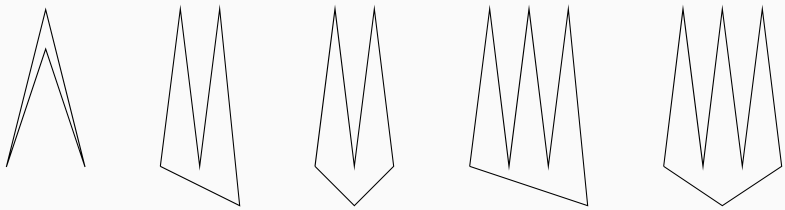
(b) Answer: Hostile concave polygons exist for all . Start from the type of zig-zag construction given in Figure below, and dislocate the vertices slightly, so as to make all distances unequal (to make each vertex have a unique closest neighbour).
Now, consider a convex hostile polygon . We say a vertex has separation when its closest neighbour is . Among all vertices, select one with minimal separation ; without loss of generality, we may take it to be , thus its closest neighbour is . Since , the vertex does not belong to the line . The closest neighbour of cannot lie on the opposite side of this line according to the auxiliary result proved above, i.e. is to be found among the vertices . But then will have separation at most , which contradicts the minimality of .
(b) Answer: Hostile concave polygons exist for all . Start from the type of zig-zag construction given in Figure below, and dislocate the vertices slightly, so as to make all distances unequal (to make each vertex have a unique closest neighbour).
Final answer
a) No convex hostile polygons exist. b) Hostile concave polygons exist for all integers n ≥ 4.
Techniques
Distance chasingTriangle inequalities