Browse · MathNet
PrintOpen Contests
Estonia geometry
Problem
On the sides , and of triangle , respectively, points , and are chosen. Prove that
Solution
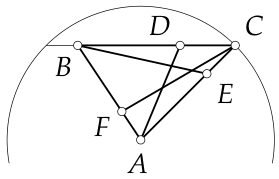
Let us first prove the second inequality. Consider the circle with centre that passes through the vertex and consider the extension of the side past the vertex up to this circle (Fig. 5). As a chord lies inside the circle, we have . We also have and . Since by the triangle inequality , we obtain .
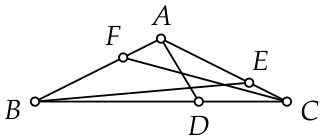
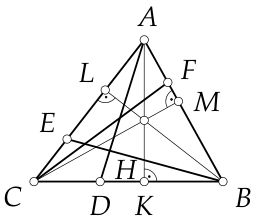
Let us now prove the first inequality. If the triangle is not acute then and (Fig. 6). Since by the triangle inequality we have , we obtain . For an acute triangle we have , and , where , and are the altitudes of the triangle . Let be the intersection point of the altitudes of the triangle (Fig. 7). We obtain , where the last inequality follows from the triangle inequality.
Fig. 5 Fig. 6 Fig. 7
---
Alternative solution.
By the triangle inequality, and , analogous inequalities hold for sides and . As not all equality cases can hold simultaneously, adding these inequalities gives a strict inequality . Collecting similar terms and dividing by 2 gives the first required inequality.
Similarly by the triangle inequality, and ; analogously for and . Again, not all equality cases can hold simultaneously, whence adding these inequalities gives a strict inequality . Collecting similar terms and dividing by 2 leads to the second required inequality.
Let us now prove the first inequality. If the triangle is not acute then and (Fig. 6). Since by the triangle inequality we have , we obtain . For an acute triangle we have , and , where , and are the altitudes of the triangle . Let be the intersection point of the altitudes of the triangle (Fig. 7). We obtain , where the last inequality follows from the triangle inequality.
Fig. 5 Fig. 6 Fig. 7
---
Alternative solution.
By the triangle inequality, and , analogous inequalities hold for sides and . As not all equality cases can hold simultaneously, adding these inequalities gives a strict inequality . Collecting similar terms and dividing by 2 gives the first required inequality.
Similarly by the triangle inequality, and ; analogously for and . Again, not all equality cases can hold simultaneously, whence adding these inequalities gives a strict inequality . Collecting similar terms and dividing by 2 leads to the second required inequality.
Techniques
Triangle inequalitiesTriangle inequalitiesDistance chasing