Browse · MathNet
PrintChina-TST-2025A
China 2025 algebra
Problem
Prove that the real-coefficient polynomial in , cannot be expressed as a finite sum of squares of real-coefficient polynomials in .
Solution
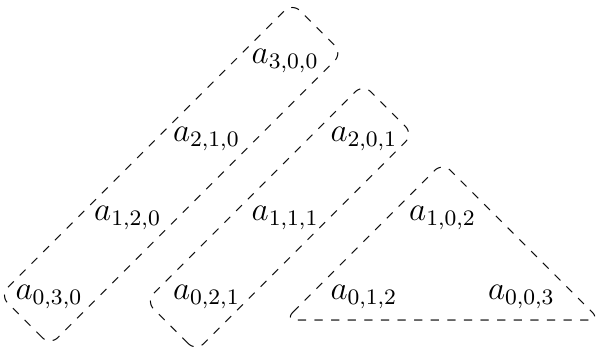
Denote the given polynomial by . By contradiction, assume there exist real-coefficient polynomials , , ..., satisfying First, all must have degree at most 3. If some had degree , then the sum of squares of their degree homogeneous parts would be 0, implying all these parts vanish, which is a contradiction! Thus all . By replacing each with its degree 3 homogeneous part, we may assume each is a homogeneous real-coefficient polynomial of degree 3. Setting in (1) yields Let . Setting in (2) gives , so for all . Thus ; similarly, setting shows . Therefore we can write , where is linear in and . Substituting into (2) and canceling gives Setting shows , so , where . In particular, the coefficients of and in are 0, and the sum of coefficients of and is 0. Now fix one and write . Then: These relations can be visualized in Figure 1, where dashed boxes enclose elements summing to 0.
Figure 1
By symmetry, we also have: In the figure, this corresponds to sums of elements along edges and diagonals being 0. From (3), the sum of all is 0. Removing the corner triangles shows . Then (4) implies: Let , , , then , , . Now, the coefficient of in is: while has coefficient 0 for . From (1), we must have for each . Substituting back into (3) and (4) shows , contradicting (1). Therefore, cannot be expressed as a finite sum of squares.
---
Alternative solution.
Denote the polynomial by . By contradiction, assume can be written as a sum of squares of real-coefficient polynomials. Then there exist () with: where each monomial in , has even degree in . Since , as in Proof 1 we may assume are homogeneous of degrees 2 and 3 respectively, with , .
Setting in (5) gives: so . Thus we can write for some . Setting in (5) and comparing coefficients of gives: so . Thus for some and . Using the identity: we may assume and for . Comparing coefficients of gives: so . Comparing coefficients of gives: Thus: Setting shows for .
Comparing coefficients of gives: Setting shows . Let for . Comparing coefficients of gives: Setting shows . Let for . From , we get , so . From , we get , so . Thus:
Setting in gives: The inequality holds for all real only when . But then setting gives , a contradiction. Therefore, cannot be expressed as a finite sum of squares of real-coefficient polynomials.
Figure 1
By symmetry, we also have: In the figure, this corresponds to sums of elements along edges and diagonals being 0. From (3), the sum of all is 0. Removing the corner triangles shows . Then (4) implies: Let , , , then , , . Now, the coefficient of in is: while has coefficient 0 for . From (1), we must have for each . Substituting back into (3) and (4) shows , contradicting (1). Therefore, cannot be expressed as a finite sum of squares.
---
Alternative solution.
Denote the polynomial by . By contradiction, assume can be written as a sum of squares of real-coefficient polynomials. Then there exist () with: where each monomial in , has even degree in . Since , as in Proof 1 we may assume are homogeneous of degrees 2 and 3 respectively, with , .
Setting in (5) gives: so . Thus we can write for some . Setting in (5) and comparing coefficients of gives: so . Thus for some and . Using the identity: we may assume and for . Comparing coefficients of gives: so . Comparing coefficients of gives: Thus: Setting shows for .
Comparing coefficients of gives: Setting shows . Let for . Comparing coefficients of gives: Setting shows . Let for . From , we get , so . From , we get , so . Thus:
Setting in gives: The inequality holds for all real only when . But then setting gives , a contradiction. Therefore, cannot be expressed as a finite sum of squares of real-coefficient polynomials.
Techniques
Polynomial operations