Browse · harp
Printsmc
algebra senior
Problem
Figures , , , and consist of , , , and nonoverlapping unit squares, respectively. If the pattern were continued, how many nonoverlapping unit squares would there be in figure 100? 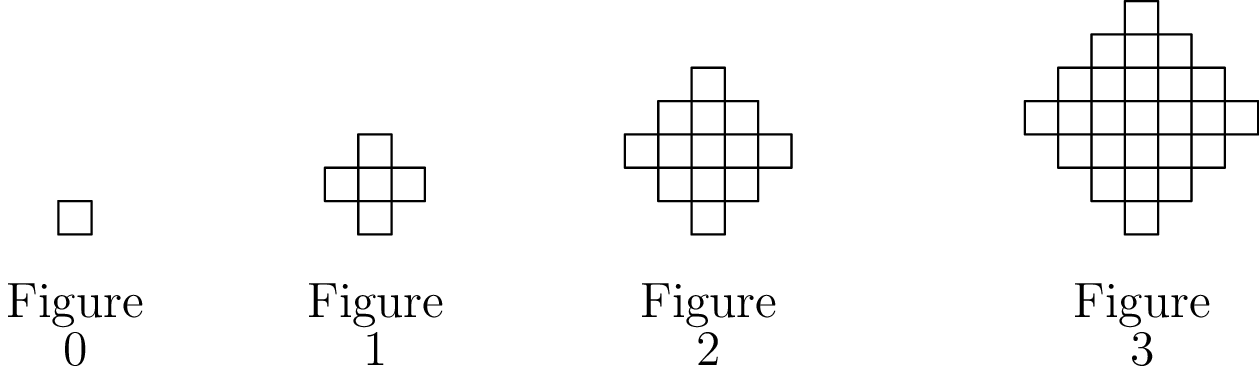
(A)
(B)
(C)
(D)
Solution
Using the recursion from solution 1, we see that the first differences of form an arithmetic progression, and consequently that the second differences are constant and all equal to . Thus, the original sequence can be generated from a quadratic function. If , and , , and , we get a system of three equations in three variables: gives gives gives Plugging in into the last two equations gives Dividing the second equation by 2 gives the system: Subtracting the first equation from the second gives , and hence . Thus, our quadratic function is: Calculating the answer to our problem, , which is choice .
Final answer
C