Browse · MathNet
PrintMongolian Mathematical Olympiad
Mongolia counting and probability
Problem
Find all positive integers for which checkers can be placed on the cells of an chessboard in such a way that each cell has exactly two neighboring cells with checkers. Two cells are considered neighbors if they share a common side.
Solution
Answer: even.
Let's start by proving that any even number is a good number. For the case we can construct a checkered pattern that all the cells of the frame contains checker and contains case in the middle. The figure below illustrates this construction:
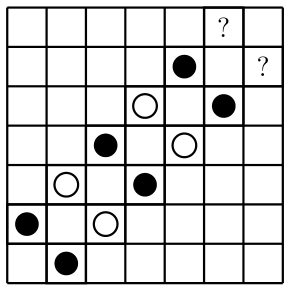
Now, let's show that for an odd number , each cell of the board cannot have exactly two checkered neighbors. To demonstrate this, we will focus on the diagonal cells of the table. Consider the neighbors of the cells for . Starting with cell , since it has exactly two neighbors, we place checkers in those neighboring cells, which are and . Now, these cells become neighbors of cell , so we do not place checkers in cells and . We continue this process for cells and , where ranges from 0 to . As a result, cells and have checkers, while cells and do not contain checkers. The figure below illustrates this construction: Now, consider cells and . Since these cells are neighbors of the corner cell , they should be checkered. However, we have already established that these cells cannot be checkered. This leads to a contradiction. Therefore, the number is not a good number.
In conclusion, we have shown that an even number is a good number, while an odd number is not a good number.
Let's start by proving that any even number is a good number. For the case we can construct a checkered pattern that all the cells of the frame contains checker and contains case in the middle. The figure below illustrates this construction:
Now, let's show that for an odd number , each cell of the board cannot have exactly two checkered neighbors. To demonstrate this, we will focus on the diagonal cells of the table. Consider the neighbors of the cells for . Starting with cell , since it has exactly two neighbors, we place checkers in those neighboring cells, which are and . Now, these cells become neighbors of cell , so we do not place checkers in cells and . We continue this process for cells and , where ranges from 0 to . As a result, cells and have checkers, while cells and do not contain checkers. The figure below illustrates this construction: Now, consider cells and . Since these cells are neighbors of the corner cell , they should be checkered. However, we have already established that these cells cannot be checkered. This leads to a contradiction. Therefore, the number is not a good number.
In conclusion, we have shown that an even number is a good number, while an odd number is not a good number.
Final answer
all even positive integers
Techniques
OtherInduction / smoothingColoring schemes, extremal arguments