Browse · MathNet
PrintEstonian Mathematical Olympiad
Estonia geometry
Problem
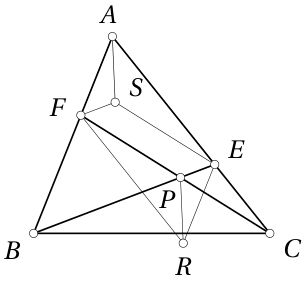
Points and are chosen respectively on the sides and of triangle . Lines and intersect at . Let be a point such that is a parallelogram and a point such that is a parallelogram. Prove that .
Solution
Let be a point such that is a parallelogram (Fig. 15). We first show that . For this note that since and . Additionally and , thus triangles and are congruent. From this we deduce that .
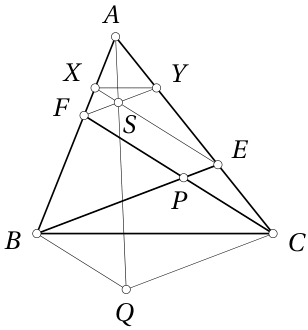
In order to prove the problem statement it now suffices to show that , and are collinear. Let be the point of intersection of and and be the point of intersection of and (Fig. 16).
First we show that . Denote and . As , we have . Thus . Analogously, we get . Consequently, , which implies .
The fact just proven implies . It suffices to notice that the triangles and are similar as their respective sides are parallel. Thus which implies . Since , this implies that the points , and are collinear.
Fig. 15 Fig. 16
---
Alternative solution.
Denote and . Take such that and . Then Take also such that and . Then Consequently, . As vectors and are not parallel, the equality can hold only if the respective coefficients are equal, i.e., and . This implies . Now we obtain The lines and being parallel is equivalent to the vectors and being parallel, which in turn is equivalent to their coefficients being proportional. Hence it suffices to show that , or equivalently, As and , we have Hence the desired equality holds and the proof is complete.
In order to prove the problem statement it now suffices to show that , and are collinear. Let be the point of intersection of and and be the point of intersection of and (Fig. 16).
First we show that . Denote and . As , we have . Thus . Analogously, we get . Consequently, , which implies .
The fact just proven implies . It suffices to notice that the triangles and are similar as their respective sides are parallel. Thus which implies . Since , this implies that the points , and are collinear.
Fig. 15 Fig. 16
---
Alternative solution.
Denote and . Take such that and . Then Take also such that and . Then Consequently, . As vectors and are not parallel, the equality can hold only if the respective coefficients are equal, i.e., and . This implies . Now we obtain The lines and being parallel is equivalent to the vectors and being parallel, which in turn is equivalent to their coefficients being proportional. Hence it suffices to show that , or equivalently, As and , we have Hence the desired equality holds and the proof is complete.
Techniques
TrianglesConcurrency and CollinearityAngle chasingConstructions and lociVectors