Browse · MATH
Printjmc
geometry senior
Problem
In the triangle shown, for to be the largest angle of the triangle, it must be that . What is the least possible value of , expressed as a common fraction? 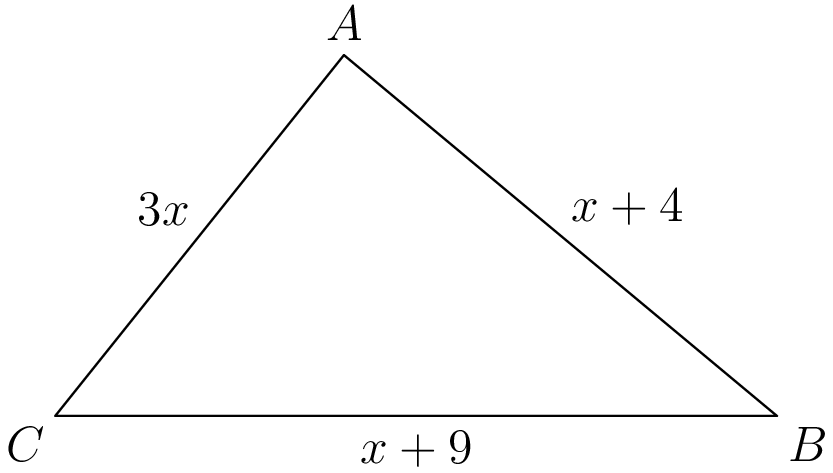
Solution
The sides of the triangle must satisfy the triangle inequality, so , , and . Substituting the side lengths, these inequalities turn into which give us , , and , respectively.
However, we also want to be the largest angle, which means that and . These inequalities turn into (which is always satisfied), and , which gives us .
Hence, must satisfy , , , and , which means The answer is .
(Also, note that every value of in this interval makes all the side lengths positive.)
However, we also want to be the largest angle, which means that and . These inequalities turn into (which is always satisfied), and , which gives us .
Hence, must satisfy , , , and , which means The answer is .
(Also, note that every value of in this interval makes all the side lengths positive.)
Final answer
\frac{17}{6}