Browse · MathNet
PrintAustriaMO2011
Austria 2011 geometry
Problem
We are given a non-isosceles triangle with incenter . Show that the circumcircle of is not tangent to the lines or .
The second common point of with is named and the second with is named . Prove that the points and are (not necessarily in this order) vertices of a trapezoid.
G. Baron, Vienna
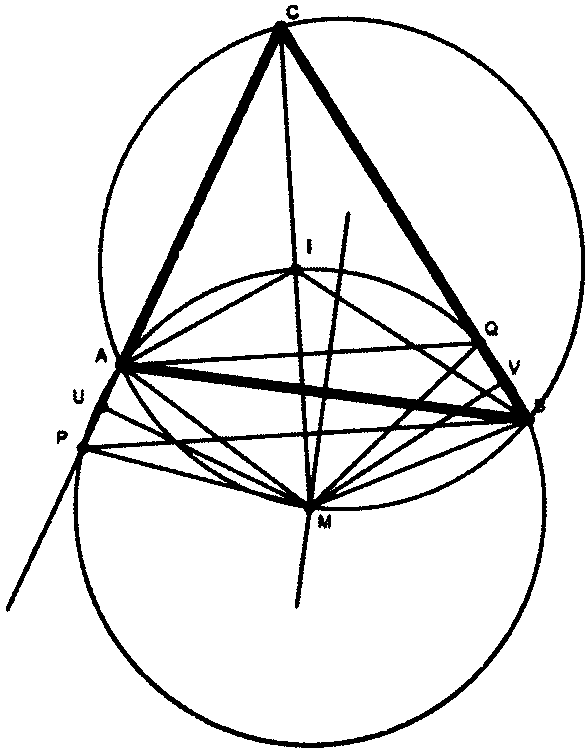
The second common point of with is named and the second with is named . Prove that the points and are (not necessarily in this order) vertices of a trapezoid.
G. Baron, Vienna
Solution
It is well known that the angle bisector in and the bisector of the side intersect in a point on the circumcircle of a triangle . Let this point be . It is certainly equidistant from and . We now consider the triangle . Naming the angles in , and , , and as usual, we note that . Furthermore, , and we therefore have . We see that the triangle is isosceles, and we have . is therefore the mid-point of .
If we name the mid-points of and and respectively, we see that triangles and are certainly congruent, since they both have angles of and and the common hypotenuse . We therefore have . Since , we now see that the triangles and are both isosceles with the same side lengths and the same altitudes, and are therefore also congruent, from which it follows that holds.
The quadrilateral is therefore inscribed and has two sides of the same length, and is therefore a trapezoid, as claimed.
We also see that neither nor can be a tangent of . If either were a tangent, the two (congruent) triangles and would both degenerate to segments perpendicular to and respectively. Both lines would therefore be tangent to , and since the tangent segments would therefore be of equal length, it would follow that is isosceles, which is a contradiction to the assumption that it is not. This completes our proof.
If we name the mid-points of and and respectively, we see that triangles and are certainly congruent, since they both have angles of and and the common hypotenuse . We therefore have . Since , we now see that the triangles and are both isosceles with the same side lengths and the same altitudes, and are therefore also congruent, from which it follows that holds.
The quadrilateral is therefore inscribed and has two sides of the same length, and is therefore a trapezoid, as claimed.
We also see that neither nor can be a tangent of . If either were a tangent, the two (congruent) triangles and would both degenerate to segments perpendicular to and respectively. Both lines would therefore be tangent to , and since the tangent segments would therefore be of equal length, it would follow that is isosceles, which is a contradiction to the assumption that it is not. This completes our proof.
Techniques
Triangle centers: centroid, incenter, circumcenter, orthocenter, Euler line, nine-point circleTangentsCyclic quadrilateralsAngle chasingDistance chasing