Browse · MathNet
PrintNational Math Olympiad
Slovenia geometry
Problem
Let be a positive integer. There are points in a plane such that no three of the points lie on the same line. A line in the plane is a divider, if two of the given points lie on this line and there are exactly points on each of the two sides. Find the greatest possible for which there are always at least dividers in the plane.
Solution
We will show that there exist at least divisor lines. First, let us give an example where there are exactly of them. For that the given points should be the vertices of a regular -gon. Denote them by . For each the line is obviously a divider. No other line is a divider, so there are exactly of them.
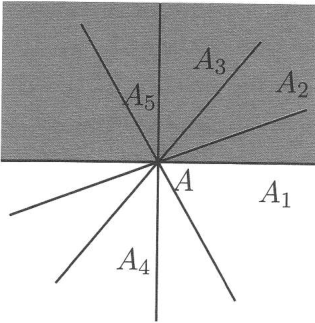
Now, let us show that we can always find at least dividers regardless of the positions of the given points. We will show that there is at least one divider passing through each of the points. Let be one of the points and denote the remaining points by . Consider the lines . Let us paint the half-plane on one of the sides of the line gray. Let be the number of points contained in the gray part (the line itself does not belong to the gray part).
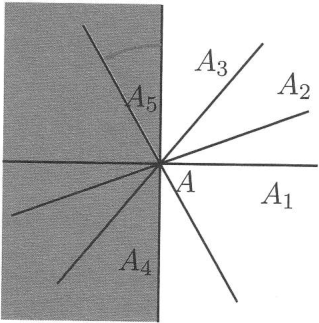
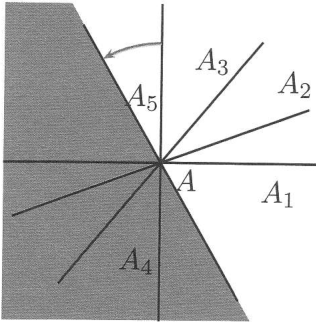
Now, let us rotate the gray part around in the positive direction. In each step rotate it so that the image of the gray part borders on the next possible line amongst . We may assume that these lines are already ordered, so we get and then again . Let be the number of the given points in the gray part after steps.
Assume that at some point we started with the line and then rotated the gray part so that it is now bordering on the line . We consider four possible cases for the positions of the points and . If was initially in the gray part and is there after the rotation, then . If was initially in the gray part and is not in the gray part after the rotation, then the number of points in the gray part decreased by 1, so . If was initially not in the gray part, then we have if is not in the gray part after the rotation. Otherwise we have .
In each step the number of points in the gray part changes by at most 1. All these numbers are integers. At the beginning there were points in the gray part. After rotations we have the situation where the gray part is once more bordering on the line , but it is not on the same side as in the beginning. So, the number of points in the gray part is in the end equal to
. If , then is a divider. If not, then one of the numbers and is greater than , and the other is smaller. After each rotation of the gray part the numbers change by 1, so after a number of steps we have . The line is then a divider.
As promised, we have shown that for each of the given points there is a divider passing through this point. There are points altogether, so we have thus obtained lines. Each line was counted twice. Hence, there are at least dividers.
Now, let us show that we can always find at least dividers regardless of the positions of the given points. We will show that there is at least one divider passing through each of the points. Let be one of the points and denote the remaining points by . Consider the lines . Let us paint the half-plane on one of the sides of the line gray. Let be the number of points contained in the gray part (the line itself does not belong to the gray part).
Now, let us rotate the gray part around in the positive direction. In each step rotate it so that the image of the gray part borders on the next possible line amongst . We may assume that these lines are already ordered, so we get and then again . Let be the number of the given points in the gray part after steps.
Assume that at some point we started with the line and then rotated the gray part so that it is now bordering on the line . We consider four possible cases for the positions of the points and . If was initially in the gray part and is there after the rotation, then . If was initially in the gray part and is not in the gray part after the rotation, then the number of points in the gray part decreased by 1, so . If was initially not in the gray part, then we have if is not in the gray part after the rotation. Otherwise we have .
In each step the number of points in the gray part changes by at most 1. All these numbers are integers. At the beginning there were points in the gray part. After rotations we have the situation where the gray part is once more bordering on the line , but it is not on the same side as in the beginning. So, the number of points in the gray part is in the end equal to
. If , then is a divider. If not, then one of the numbers and is greater than , and the other is smaller. After each rotation of the gray part the numbers change by 1, so after a number of steps we have . The line is then a divider.
As promised, we have shown that for each of the given points there is a divider passing through this point. There are points altogether, so we have thus obtained lines. Each line was counted twice. Hence, there are at least dividers.
Final answer
n + 1
Techniques
RotationConstructions and lociCounting two ways