Browse · MathNet
PrintTHE 68th NMO SELECTION TESTS FOR THE JUNIOR BALKAN MATHEMATICAL OLYMPIAD
Romania counting and probability
Problem
Two right isosceles triangles of legs equal to are glued together to form either an isosceles triangle – called t-shape – of leg , or a parallelogram – called p-shape – of sides and . Find all integers and , , such that a rectangle can be tiled with t-shapes and p-shapes.
Solution
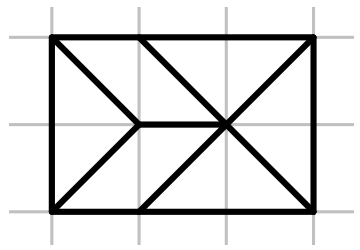
To this end, notice that t-shapes can be glued to produce a square, which is sufficient for tiling a rectangle with both sides even. If is odd, a rectangle can be obtained as below:
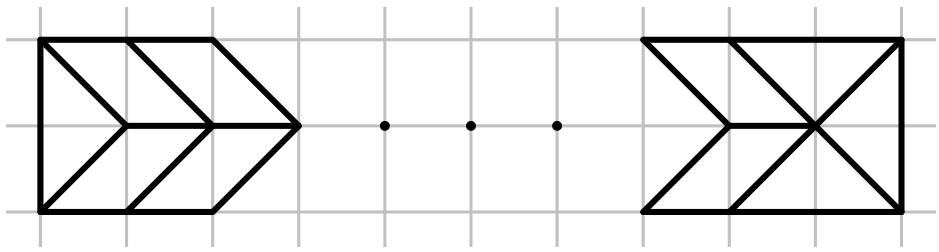
Alternatively, we can tile any rectangle , with tiles as follows:
Obviously a rectangle can not be tiled for any . Any way one would position the tiles, the one that covers one of the vertices of the rectangle renders impossible the covering of the closest vertex. It is left to prove that any odd sided rectangle cannot be tessellated. For this, color the unit squares of an rectangle with odd in a chessboard pattern, with the corners being black. On one hand, we have more black squares than white squares, on the other hand each tile covers a surface area that is half black, half white, so the total surface area covered by the tiles is half black, half white. In conclusion, the surface of a rectangle with both dimensions odd can not be tiled. In conclusion, the tiling is possible if and only if and at least one dimension is even.
Alternatively, we can tile any rectangle , with tiles as follows:
Obviously a rectangle can not be tiled for any . Any way one would position the tiles, the one that covers one of the vertices of the rectangle renders impossible the covering of the closest vertex. It is left to prove that any odd sided rectangle cannot be tessellated. For this, color the unit squares of an rectangle with odd in a chessboard pattern, with the corners being black. On one hand, we have more black squares than white squares, on the other hand each tile covers a surface area that is half black, half white, so the total surface area covered by the tiles is half black, half white. In conclusion, the surface of a rectangle with both dimensions odd can not be tiled. In conclusion, the tiling is possible if and only if and at least one dimension is even.
Final answer
All m and n at least two with at least one of m or n even.
Techniques
Coloring schemes, extremal argumentsInvariants / monovariants