Browse · MATH
Printjmc
geometry senior
Problem
In the diagram, four circles of radius 1 with centres , , , and are tangent to one another and to the sides of , as shown. 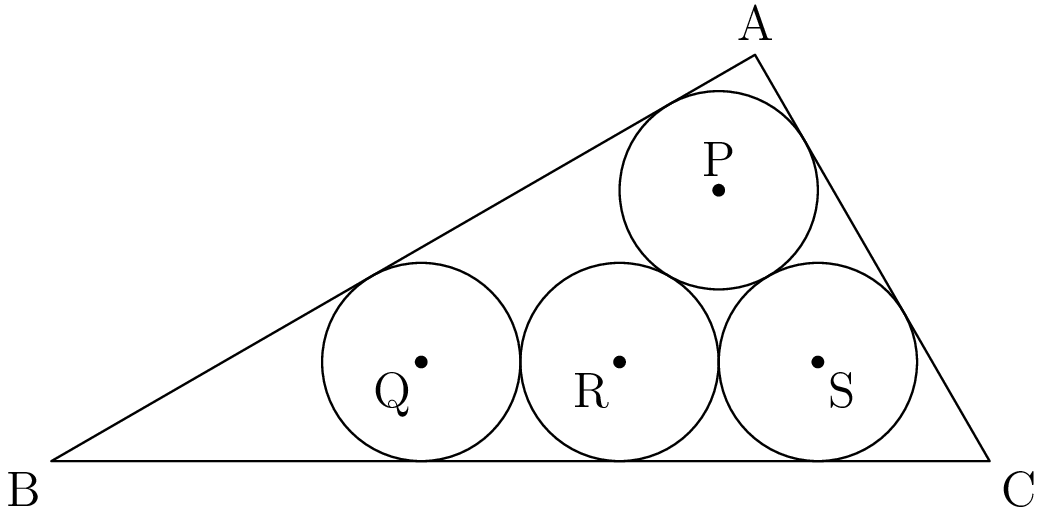
The radius of the circle with center is decreased so that
the circle with center remains tangent to ,
the circle with center remains tangent to the other three circles, and
the circle with center becomes tangent to the other three circles.
The radii and tangencies of the other three circles stay the same. This changes the size and shape of . is the new radius of the circle with center . is of the form . Find .
The radius of the circle with center is decreased so that
the circle with center remains tangent to ,
the circle with center remains tangent to the other three circles, and
the circle with center becomes tangent to the other three circles.
The radii and tangencies of the other three circles stay the same. This changes the size and shape of . is the new radius of the circle with center . is of the form . Find .
Solution
After the described transformation, we obtain the following diagram.
Drop perpendiculars from , and to , and respectively on .
Since the circles with centers , and are tangent to , then , and are the points of tangency of these circles to . Thus, and .
Join , , , , and . Since we are connecting centers of tangent circles, and .
Join . By symmetry, is a straight line (that is, passes through ). Since is parallel to , is perpendicular to , meeting at .
Since , . Since , . Since , and is right-angled at , then by the Pythagorean Theorem, Since and , then . Since is right-angled at , By the quadratic formula, . Since , then (which is the reciprocal of the famous ``golden ratio"). Thus, .
Drop perpendiculars from , and to , and respectively on .
Since the circles with centers , and are tangent to , then , and are the points of tangency of these circles to . Thus, and .
Join , , , , and . Since we are connecting centers of tangent circles, and .
Join . By symmetry, is a straight line (that is, passes through ). Since is parallel to , is perpendicular to , meeting at .
Since , . Since , . Since , and is right-angled at , then by the Pythagorean Theorem, Since and , then . Since is right-angled at , By the quadratic formula, . Since , then (which is the reciprocal of the famous ``golden ratio"). Thus, .
Final answer
6