Browse · MathNet
PrintChina Girls' Mathematical Olympiad
China geometry
Problem
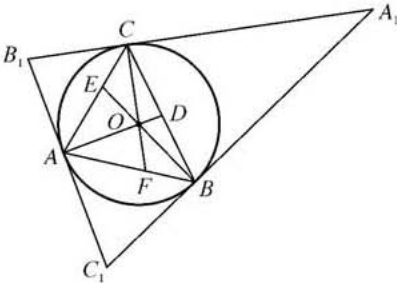
Let be an acute triangle. Points , and lie on segments , and respectively, and each of the three segments , and contains the circumcenter of . Prove that if any two of the ratios are integers, then triangle is isosceles.
Solution
Proof I Note that there are possible pairs of ratios among the six given in the problem statement. These pairs are of two types: (i) Three of these pairs are reciprocal pairs involving segments from just one side of triangle . (ii) The other 12 pairs involve segments from two sides of the triangle. We first consider the former case.
a. If and are both integers, then both of these ratios must be 1 and . Then in triangle , is the median from and , because contains the circumcenter, is also the perpendicular bisector of segment . It then follows that and the triangle is isosceles. Similarly, if and are both integers or and are both integers, then triangle is isosceles.
b. Let be the circumcenter of triangle , and let
, , and . We show that any of the ratios can be written in the form where and are two of . Since is acute, and lies in the interior. Hence , , and . Applying the sine rule to triangles and gives and Next note that and that It follows that giving . Similarly, and .
Now assume that one of the twelve type (ii) pairs of ratios consists of two integers. Then there are positive integers and (with ) such that or for some choice of with .
Without loss of generality we may assume that or for some positive integers and .
Note that there is a triangle with angles , , and . (It is easy to check that each of these angles is in the interval and that they sum to .) Furthermore, a triangle with these angles can be constructed by drawing the tangents to the circumcircle of at each of , and . Denote this triangle by where is the intersection of the tangents at and , is the intersection of the tangents at and , and is the intersection of the tangents at and . Applying the sine rule to triangle and by we find that is, or By the triangle inequality, it follows that (that is, ) or (that is, and ). We deduce that either or . But then either or , by case (a), triangle is isosceles.
Proof II (We maintain the notations used in Proof I.) We only consider those 12 pairs of ratios of type (ii). Without loss of generality we may assume that each of the following sets and has an element taking integer values. By symmetry, we consider three cases:
a. In this case, we assume that and for some positive integers and . Applying Menelaus's theorem to line and triangle yields or Likewise, applying Menelaus's theorem to line and triangle yields .
Since triangle is acute, lies on segment and with and . Hence and , implying that . Since and are integers, we must have . It is then not difficult to see that and are symmetric with respect to line and triangle is isosceles with .
b. In this case, we assume that and for some positive integers and . Applying Ceva's theorem gives Applying Menelaus's theorem to line and triangle yields or Since triangle is acute, lies on segment and . Hence or . Since and are positive integers, we deduce that one of and is equal to 1; that is, either or . In either case, triangle is isosceles.
a. If and are both integers, then both of these ratios must be 1 and . Then in triangle , is the median from and , because contains the circumcenter, is also the perpendicular bisector of segment . It then follows that and the triangle is isosceles. Similarly, if and are both integers or and are both integers, then triangle is isosceles.
b. Let be the circumcenter of triangle , and let
, , and . We show that any of the ratios can be written in the form where and are two of . Since is acute, and lies in the interior. Hence , , and . Applying the sine rule to triangles and gives and Next note that and that It follows that giving . Similarly, and .
Now assume that one of the twelve type (ii) pairs of ratios consists of two integers. Then there are positive integers and (with ) such that or for some choice of with .
Without loss of generality we may assume that or for some positive integers and .
Note that there is a triangle with angles , , and . (It is easy to check that each of these angles is in the interval and that they sum to .) Furthermore, a triangle with these angles can be constructed by drawing the tangents to the circumcircle of at each of , and . Denote this triangle by where is the intersection of the tangents at and , is the intersection of the tangents at and , and is the intersection of the tangents at and . Applying the sine rule to triangle and by we find that is, or By the triangle inequality, it follows that (that is, ) or (that is, and ). We deduce that either or . But then either or , by case (a), triangle is isosceles.
Proof II (We maintain the notations used in Proof I.) We only consider those 12 pairs of ratios of type (ii). Without loss of generality we may assume that each of the following sets and has an element taking integer values. By symmetry, we consider three cases:
a. In this case, we assume that and for some positive integers and . Applying Menelaus's theorem to line and triangle yields or Likewise, applying Menelaus's theorem to line and triangle yields .
Since triangle is acute, lies on segment and with and . Hence and , implying that . Since and are integers, we must have . It is then not difficult to see that and are symmetric with respect to line and triangle is isosceles with .
b. In this case, we assume that and for some positive integers and . Applying Ceva's theorem gives Applying Menelaus's theorem to line and triangle yields or Since triangle is acute, lies on segment and . Hence or . Since and are positive integers, we deduce that one of and is equal to 1; that is, either or . In either case, triangle is isosceles.
Techniques
Triangle centers: centroid, incenter, circumcenter, orthocenter, Euler line, nine-point circleCeva's theoremMenelaus' theoremTangentsTrigonometryTriangle trigonometryAngle chasing