Browse · MathNet
PrintChina National Team Selection Test
China geometry
Problem
Let be a point on side of triangle such that . A circle with center passes through , , and meets segments , at , , respectively. Lines and meet at point . is the midpoint of . Prove that . (Posed by Xiong Bin)
Solution
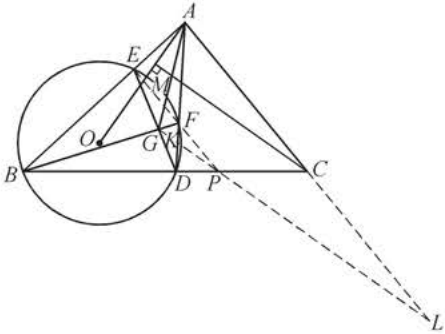
As shown in Fig. 1, extend and meet at point , and join and extend , which meets at and the extension of at .
Fig. 1
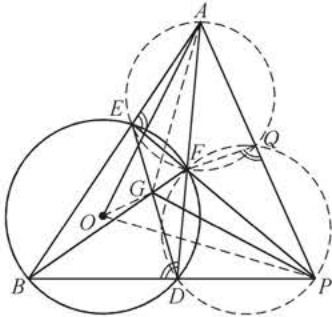
As shown in Fig. 2, let be a point on such that It is easy to see that and are concyclic respectively. Denote by the radius of . By the power of a point theorem, ①
Similarly, ②
By ①, ②, we have , which implies that .
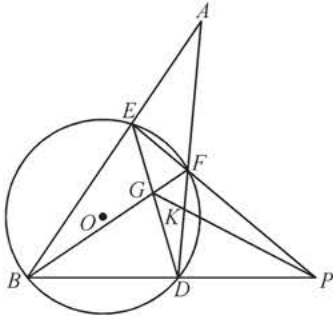
As shown in Fig. 3, applying Menelaus' theorem for and line , we have
Fig. 2
Applying Ceva's theorem for and point , we have
③ ④ yields
Fig. 3
Equation ⑤ illustrates that are harmonic points with respect to , i.e. .
It follows that
Since are concyclic, we have . Since , we have , which implies that . Thus,
Applying Menelaus' theorem to and line , we have
Combining ⑥, ⑦ and ⑧, we have .
In , are the midpoints of respectively, and hence . Since , we conclude that .
Fig. 1
As shown in Fig. 2, let be a point on such that It is easy to see that and are concyclic respectively. Denote by the radius of . By the power of a point theorem, ①
Similarly, ②
By ①, ②, we have , which implies that .
As shown in Fig. 3, applying Menelaus' theorem for and line , we have
Fig. 2
Applying Ceva's theorem for and point , we have
③ ④ yields
Fig. 3
Equation ⑤ illustrates that are harmonic points with respect to , i.e. .
It follows that
Since are concyclic, we have . Since , we have , which implies that . Thus,
Applying Menelaus' theorem to and line , we have
Combining ⑥, ⑦ and ⑧, we have .
In , are the midpoints of respectively, and hence . Since , we conclude that .
Techniques
Menelaus' theoremCeva's theoremPolar triangles, harmonic conjugatesRadical axis theoremAngle chasing