Browse · MathNet
PrintXXVII Olimpiada Matemática Rioplatense
Argentina counting and probability
Problem
Lucía writes the integer numbers from to , in some order, around a circumference. Then, she calculates the sum of each pair of adjacent numbers, thus obtaining sums. We call the largest of these sums and the smallest. Find the minimum possible value of .
Show how Lucía can write the numbers to obtain that minimum value and explain why it is not possible to obtain a smaller value.
Show how Lucía can write the numbers to obtain that minimum value and explain why it is not possible to obtain a smaller value.
Solution
It is easy to see that . Indeed, we have if and only if the sums are all equal; however, if are three consecutive numbers on the circumference, the sums and are different, since .
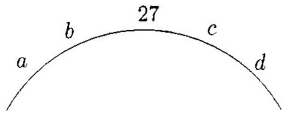
We will now prove that it is not possible that . If this is the case, when considering three consecutive numbers on the circumference, the sums and differ by , since they are not equal, and so, and differ by . Now look at the place where the number is located; assume the previous numbers are and the following are .
By the previous arguments, and differ by , and the same happens with and . But the only written number that differs by with is ; then, both and would be equal to , a contradiction. This proves that we cannot achieve .
Finally, we show an example where .
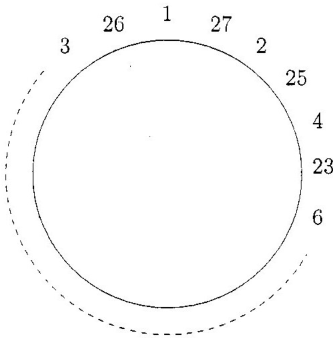
First, Lucía writes number and then, she alternates odd and even numbers, writing odd numbers in decreasing order and even numbers in increasing order.
16
The first sum is and, the following ones are alternately and . Therefore, , as stated.
We will now prove that it is not possible that . If this is the case, when considering three consecutive numbers on the circumference, the sums and differ by , since they are not equal, and so, and differ by . Now look at the place where the number is located; assume the previous numbers are and the following are .
By the previous arguments, and differ by , and the same happens with and . But the only written number that differs by with is ; then, both and would be equal to , a contradiction. This proves that we cannot achieve .
Finally, we show an example where .
First, Lucía writes number and then, she alternates odd and even numbers, writing odd numbers in decreasing order and even numbers in increasing order.
16
The first sum is and, the following ones are alternately and . Therefore, , as stated.
Final answer
2
Techniques
Coloring schemes, extremal arguments