Browse · MathNet
PrintUSA IMO
United States geometry
Problem
In a triangle , let segment bisect , with on side , and let segment bisect , with on side . It is known that and that . What are the possible angles of triangle ?
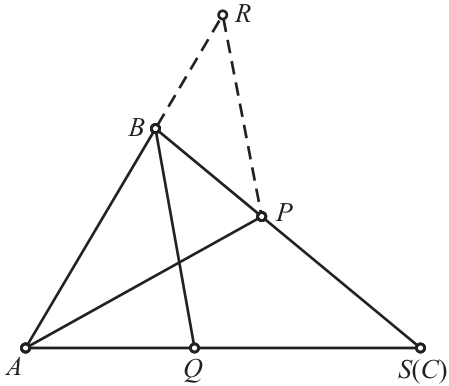
Solution
First Solution. (by Reid Barton and Gabriel Carroll) Extend segment through to so that , and construct on ray so that .
Lemma 1. Points , , are collinear, and consequently, coincides with .
Proof. Because , triangle is isosceles with base angles Note that and , implying that triangle is equilateral. Since line bisects , and are symmetric with respect to line . Thus, and , or . By (2), we have
Because , . Hence, triangle is isosceles with
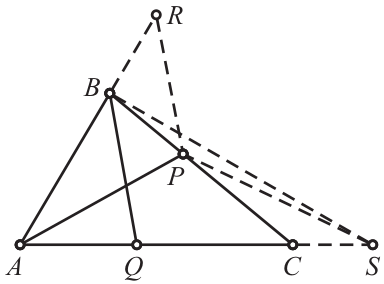
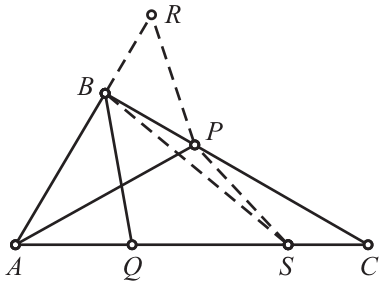
Now, assume to the contrary that triangle is nondegenerate. Then either , as in the first diagram below, or , as in the second diagram.
In either diagram, combining (4) and (5) gives that is, triangle is isosceles with . By (3), it follows that . Hence, triangle is equilateral. But then , and by (1), , which is absurd. Therefore, our assumption was wrong and are collinear. Consequently, . ■
---
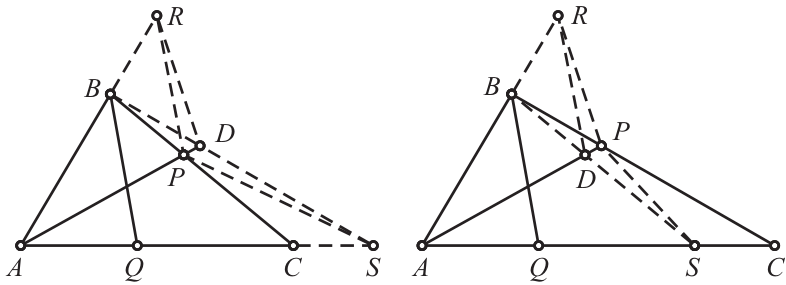
Second Solution. (By Zhiqiang Zhang, China) Construct on ray beyond such that , and construct on ray beyond such that . Let lines and intersect at . Note that . Then both triangles and are isosceles with and
Because , equation (1) implies . Because and , we also have that . Using these relations as well as (6), we find that , implying that is inside triangle . We now consider two cases.
i. . Since , , so by (1), and . We need to check whether such a triangle has the desired properties. Setting , in isosceles triangle we have . Hence, . This equality, along with the equations and , implies that triangles and are congruent. Thus, , or . Therefore, , , and are possible angles of triangle .
ii. .
Since and is the angle bisector of angles and , and are symmetric with respect to line , and . By (7), we have By subtraction, from (6) and (8) we obtain Because are on the same side of line (specifically, between rays and ), quadrilateral must be cyclic. Hence, . Because angle is an exterior angle of triangle , by using (1), we have . On the other hand, by (8) and (7), Now the relation reads or . But then , which is impossible. Thus, there is no solution under the assumption .
---
Third Solution. (By Liang Xiao, China) Construct on ray beyond such that and on ray beyond such that . Note that and hence, because , triangle is equilateral. Now we calculate a few angles: Noting that and , we apply the Law of Sines to triangles , , and to obtain Writing these angles in terms of , we have Now, and hence . Cancelling the common terms and clearing the denominators of the above equation, we obtain Using the Product-to-sum formulas gives or Applying the Sum-to-product formulas yields Hence, either or . The first case is impossible because . In the second, , implying that and . Consequently, it is easy to check that and . Therefore, , , and .
---
Fourth Solution. (By Hui Zheng, China) Applying the Law of Sines to triangles and yields and Thus, the condition implies that or By (1), and . Applying the Difference-to-product formulas twice yields By the Double-angle formulas, the numerator on the left-hand side is Plugging in this expression and then dividing by — which is nonzero because — we find that Clearing the denominator and applying the Product-to-sum formulas, the last equation becomes or by applying the Difference-to-product formulas. Hence, The only solution to either equation in the range is . Thus, , , and .
---
Fifth Solution. (By Kiran Kedlaya) We use complex numbers in this solution. Rewrite (12) as Set and . Because , we know that . Now, and . Also, It follows that , , , and . We rewrite (13) in terms of : The second term on the left-hand side of (15) is and the third term simplifies to Thus, (15) simplifies to Clearing the denominators in this equations yields If , then triangles and are approximately equilateral and . Thus, we suspect that is a solution
---
of the above equation. With this in mind, we factor (14) as follows: Hence, , so , , or . yielding , or . The only value in the range is , so , , and .
---
Sixth Solution. (By Belur Jana Venkatachala, India) Let , , , and . By the Angle Bisector Theorem, we obtain Lemma 2. We have Proof. Let denote the area of region . Then, or By the Law of Cosines, we obtain Applying the Double-angle formulas yields or . Substituting this into (17) yields the desired result. (The result also follows directly from the Angle Bisector Theorem and the Stewart's Theorem.) ■
By lemma 2, the given condition reads or Clearing the denominators yields Since (18) can be rewritten as Taking , we obtain a quadratic in : or . Thus, If , then , leading to or . This equation and the Law of Cosines imply that , which is absurd.
If , then , leading to Hence, or By the second part of (16), the last equation is which, along with , implies that triangles and are similar. Hence, , that is, , , and .
---
Therefore, , , and is the only solution.
Lemma 1. Points , , are collinear, and consequently, coincides with .
Proof. Because , triangle is isosceles with base angles Note that and , implying that triangle is equilateral. Since line bisects , and are symmetric with respect to line . Thus, and , or . By (2), we have
Because , . Hence, triangle is isosceles with
Now, assume to the contrary that triangle is nondegenerate. Then either , as in the first diagram below, or , as in the second diagram.
In either diagram, combining (4) and (5) gives that is, triangle is isosceles with . By (3), it follows that . Hence, triangle is equilateral. But then , and by (1), , which is absurd. Therefore, our assumption was wrong and are collinear. Consequently, . ■
---
Second Solution. (By Zhiqiang Zhang, China) Construct on ray beyond such that , and construct on ray beyond such that . Let lines and intersect at . Note that . Then both triangles and are isosceles with and
Because , equation (1) implies . Because and , we also have that . Using these relations as well as (6), we find that , implying that is inside triangle . We now consider two cases.
i. . Since , , so by (1), and . We need to check whether such a triangle has the desired properties. Setting , in isosceles triangle we have . Hence, . This equality, along with the equations and , implies that triangles and are congruent. Thus, , or . Therefore, , , and are possible angles of triangle .
ii. .
Since and is the angle bisector of angles and , and are symmetric with respect to line , and . By (7), we have By subtraction, from (6) and (8) we obtain Because are on the same side of line (specifically, between rays and ), quadrilateral must be cyclic. Hence, . Because angle is an exterior angle of triangle , by using (1), we have . On the other hand, by (8) and (7), Now the relation reads or . But then , which is impossible. Thus, there is no solution under the assumption .
---
Third Solution. (By Liang Xiao, China) Construct on ray beyond such that and on ray beyond such that . Note that and hence, because , triangle is equilateral. Now we calculate a few angles: Noting that and , we apply the Law of Sines to triangles , , and to obtain Writing these angles in terms of , we have Now, and hence . Cancelling the common terms and clearing the denominators of the above equation, we obtain Using the Product-to-sum formulas gives or Applying the Sum-to-product formulas yields Hence, either or . The first case is impossible because . In the second, , implying that and . Consequently, it is easy to check that and . Therefore, , , and .
---
Fourth Solution. (By Hui Zheng, China) Applying the Law of Sines to triangles and yields and Thus, the condition implies that or By (1), and . Applying the Difference-to-product formulas twice yields By the Double-angle formulas, the numerator on the left-hand side is Plugging in this expression and then dividing by — which is nonzero because — we find that Clearing the denominator and applying the Product-to-sum formulas, the last equation becomes or by applying the Difference-to-product formulas. Hence, The only solution to either equation in the range is . Thus, , , and .
---
Fifth Solution. (By Kiran Kedlaya) We use complex numbers in this solution. Rewrite (12) as Set and . Because , we know that . Now, and . Also, It follows that , , , and . We rewrite (13) in terms of : The second term on the left-hand side of (15) is and the third term simplifies to Thus, (15) simplifies to Clearing the denominators in this equations yields If , then triangles and are approximately equilateral and . Thus, we suspect that is a solution
---
of the above equation. With this in mind, we factor (14) as follows: Hence, , so , , or . yielding , or . The only value in the range is , so , , and .
---
Sixth Solution. (By Belur Jana Venkatachala, India) Let , , , and . By the Angle Bisector Theorem, we obtain Lemma 2. We have Proof. Let denote the area of region . Then, or By the Law of Cosines, we obtain Applying the Double-angle formulas yields or . Substituting this into (17) yields the desired result. (The result also follows directly from the Angle Bisector Theorem and the Stewart's Theorem.) ■
By lemma 2, the given condition reads or Clearing the denominators yields Since (18) can be rewritten as Taking , we obtain a quadratic in : or . Thus, If , then , leading to or . This equation and the Law of Cosines imply that , which is absurd.
If , then , leading to Hence, or By the second part of (16), the last equation is which, along with , implies that triangles and are similar. Hence, , that is, , , and .
---
Therefore, , , and is the only solution.
Final answer
∠ABC = 80°, ∠BCA = 40°, ∠CAB = 60°
Techniques
Triangle trigonometryAngle chasingCyclic quadrilateralsTrigonometryComplex numbers in geometry