Browse · MathNet
PrintThe South African Mathematical Olympiad Third Round
South Africa geometry
Problem
Let be the centre of a two-dimensional coordinate system, and let be points in the first quadrant and points in the second quadrant. We associate numbers to the points and numbers to the points , respectively. It turns out that the area of triangle is always equal to the product , for any and . Show that either all the or all the lie on a single line through .
Solution
Consider first the case that one of the areas is zero, e.g. . Then either or . If , then for all , which means that all lie on a straight line through and . Likewise, if , then all lie on a straight line through and . So we can assume from now on that none of the areas is zero.
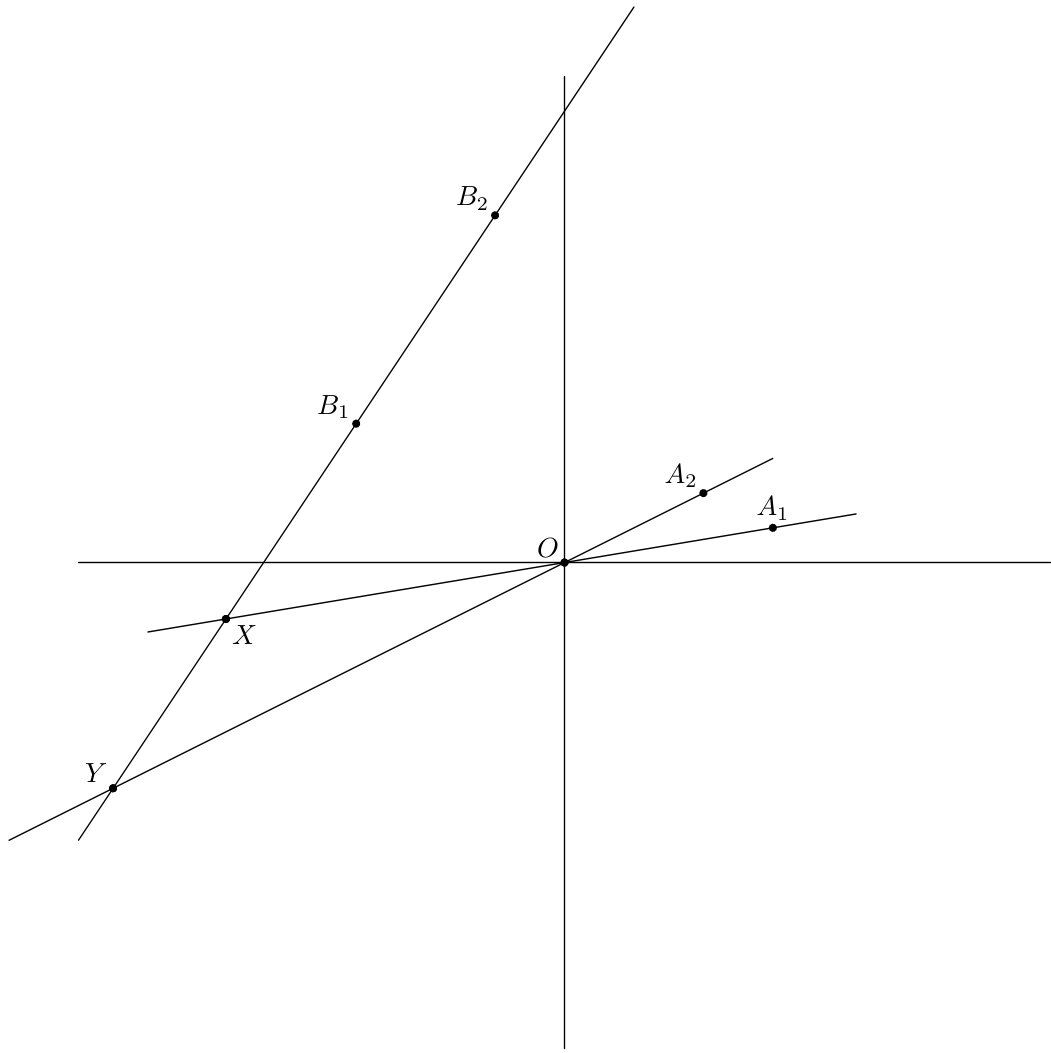
Suppose there are two points among that are not on the same line through (since the numbering does not matter, we can assume that and have this property), and at the same time there are two points (again, we can assume them to be and ) that are not on the same line through . We have Since triangles and have the same base (), their heights must be in a -ratio. The same is true for the heights of triangles and . If is parallel to , then , so is parallel to . In this case, and lie on one line, contradicting the assumption. The same argument applies if is parallel to .
If neither nor is parallel to , let be the intersection of and , and let be the intersection of and .
Since and are in the first quadrant, and are either in the first or third quadrant. In either case, they are not between and . Using similar triangles, we see that the ratio of the heights of and is , which must be . The same is true (analogously) for the ratio . Hence If and are on different sides of , one of these ratios is greater than 1, the other less than 1, a contradiction. Thus we assume that is closer to both and (otherwise, we just interchange the roles of and ), as in the figure. We get and thus . This means that and coincide, so lie on one line, and we get a contradiction to our assumption again. This completes the proof.
---
Alternative solution.
We argue as in the first proof and assume again that and do not lie on a common line through , and that and do not lie on a common line through . Let be the angles enclosed by and with the x-axis. Then and thus It follows that Now we use the trigonometric identity to get This implies and by the addition theorem for the cosine so finally which means that either or , contradicting our assumption and thus completing the proof.
Suppose there are two points among that are not on the same line through (since the numbering does not matter, we can assume that and have this property), and at the same time there are two points (again, we can assume them to be and ) that are not on the same line through . We have Since triangles and have the same base (), their heights must be in a -ratio. The same is true for the heights of triangles and . If is parallel to , then , so is parallel to . In this case, and lie on one line, contradicting the assumption. The same argument applies if is parallel to .
If neither nor is parallel to , let be the intersection of and , and let be the intersection of and .
Since and are in the first quadrant, and are either in the first or third quadrant. In either case, they are not between and . Using similar triangles, we see that the ratio of the heights of and is , which must be . The same is true (analogously) for the ratio . Hence If and are on different sides of , one of these ratios is greater than 1, the other less than 1, a contradiction. Thus we assume that is closer to both and (otherwise, we just interchange the roles of and ), as in the figure. We get and thus . This means that and coincide, so lie on one line, and we get a contradiction to our assumption again. This completes the proof.
---
Alternative solution.
We argue as in the first proof and assume again that and do not lie on a common line through , and that and do not lie on a common line through . Let be the angles enclosed by and with the x-axis. Then and thus It follows that Now we use the trigonometric identity to get This implies and by the addition theorem for the cosine so finally which means that either or , contradicting our assumption and thus completing the proof.
Techniques
Concurrency and CollinearityTriangle trigonometryTrigonometryDistance chasing