Browse · MathNet
PrintChina Western Mathematical Olympiad
China geometry
Problem
Suppose the sum of distances from any point in a convex quadrilateral to lines , , and is constant. Prove that is a parallelogram. (posed by Xiong Bin)
Solution
Let denote the distance from point to line . We first prove the following lemma.
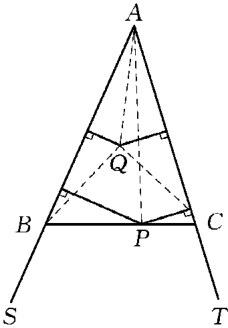
Lemma Let be a given angle and a moving point in . If the sum of distances from to lines and is a constant number , then the trace of is a segment of with points and on and respectively, and . Further, if a point lies inside , then the sum of distances from to lines and is less than , and it is greater than if lies outside .
Proof of Lemma For and on , we have , i.e. . Then . If point lies inside , , then . If lies outside , , then . The proof of Lemma is complete.
We now consider the following two cases:
(1) Neither pair of the opposite sides of the quadrilateral is parallel. We may assume that sides and meet at point and sides and meet at point . Through point draw segments and such that the sum of distances from any point on to and is constant and the sum of distances from any point on to and is also constant. As seen in the second figure, for any point in area , using the given condition and the lemma, we have
It leads to a contradiction.
(2) The quadrilateral is a trapezoid. In the same way, we can also show that it will lead to a contradiction.
This completes the proof.
Lemma Let be a given angle and a moving point in . If the sum of distances from to lines and is a constant number , then the trace of is a segment of with points and on and respectively, and . Further, if a point lies inside , then the sum of distances from to lines and is less than , and it is greater than if lies outside .
Proof of Lemma For and on , we have , i.e. . Then . If point lies inside , , then . If lies outside , , then . The proof of Lemma is complete.
We now consider the following two cases:
(1) Neither pair of the opposite sides of the quadrilateral is parallel. We may assume that sides and meet at point and sides and meet at point . Through point draw segments and such that the sum of distances from any point on to and is constant and the sum of distances from any point on to and is also constant. As seen in the second figure, for any point in area , using the given condition and the lemma, we have
It leads to a contradiction.
(2) The quadrilateral is a trapezoid. In the same way, we can also show that it will lead to a contradiction.
This completes the proof.
Techniques
QuadrilateralsConstructions and lociDistance chasingTriangle trigonometry