Browse · MathNet
Print33rd Hellenic Mathematical Olympiad
Greece counting and probability
Problem
Square is divided into equal elementary squares, by drawing parallel lines to their sides. We call the vertices of the elementary squares points of the lattice. One rhombus will be called “good”, if it is not a square, their vertices are points of the lattice and their diagonals are parallel to the sides of the square . Find a closed formula, with respect to , of the number of “good” rhombuses, where is integer greater than .
Solution
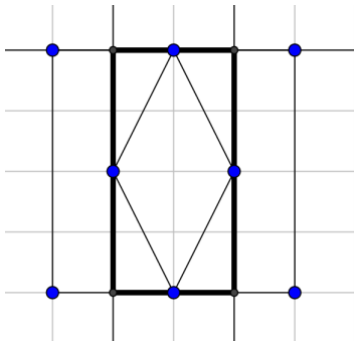
Drawing from the vertices of the rhombus parallel lines to the sides of the lattice, we find the least rectangle in which the rhombus is inscribed. Since the rhombus is symmetric with respect to its center, this rectangle will have sides with even length. Therefore it is enough to count the rectangles with even sides , for which . It is equivalent to count first all rectangles and then subtract all squares .
Let
We count all vertical lines of the lattice from left to right by and all horizontal lines from bottom to top by . A rectangle is determined from two vertical lines and two horizontal lines having even distance. Two lines have even distance when their numbers are of the same parity. We can select two vertical lines with even numbers and even distance in ways, while to select two vertical lines with odd numbers and even distance we have ways. Therefore, the total number of ways to select two vertical lines with even distance is . Similarly, we have possible selections for the horizontal lines. In total, we have rectangles of the type .
It remains to subtract all squares . The squares are totally . The squares are totally . In general, the squares are totally . Hence we have Therefore all rhombuses in the even case are:
Let . Then, similarly, we have possible selections for the two vertical lines and possible selections for the horizontal lines. Totally we have rectangles . We have to subtract the squares which totally are Hence we have Hence in the odd case the rhombuses are totally
Let
We count all vertical lines of the lattice from left to right by and all horizontal lines from bottom to top by . A rectangle is determined from two vertical lines and two horizontal lines having even distance. Two lines have even distance when their numbers are of the same parity. We can select two vertical lines with even numbers and even distance in ways, while to select two vertical lines with odd numbers and even distance we have ways. Therefore, the total number of ways to select two vertical lines with even distance is . Similarly, we have possible selections for the horizontal lines. In total, we have rectangles of the type .
It remains to subtract all squares . The squares are totally . The squares are totally . In general, the squares are totally . Hence we have Therefore all rhombuses in the even case are:
Let . Then, similarly, we have possible selections for the two vertical lines and possible selections for the horizontal lines. Totally we have rectangles . We have to subtract the squares which totally are Hence we have Hence in the odd case the rhombuses are totally
Final answer
If n is even: n(n−2)(3n^2 − 2n − 4)/48. If n is odd: (n^2 − 1)(3n^2 − 8n − 3)/48.
Techniques
Counting two waysSums and products