Browse · MATH
Printjmc
counting and probability intermediate
Problem
In triangle , , , and .
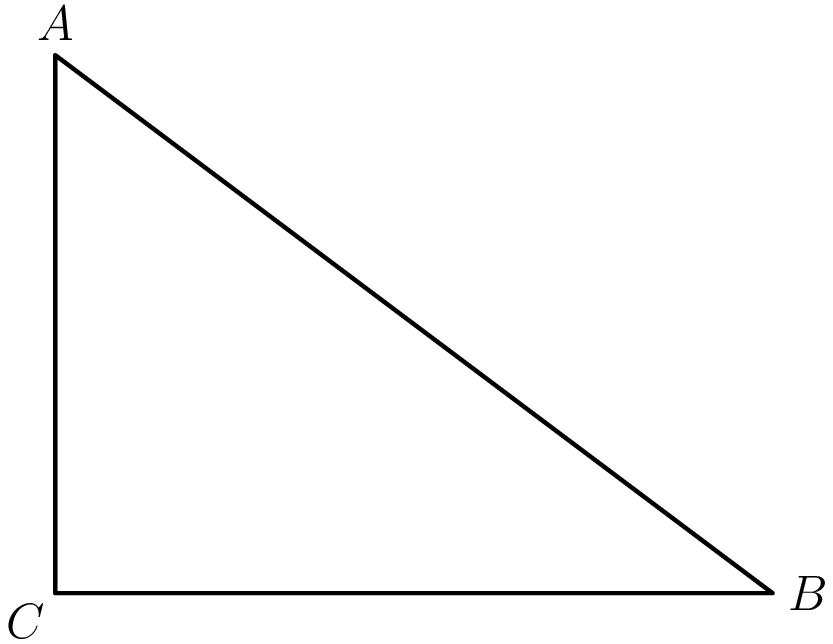
Point is randomly selected inside triangle . What is the probability that is closer to than it is to either or ?
Point is randomly selected inside triangle . What is the probability that is closer to than it is to either or ?
Solution
Let be the perpendicular bisector of segment . We note that the points that are closer to than they are to are the points that are on the same side of as .
Since is a 3-4-5 right triangle with a right angle at , is parallel to line . Since it passes through the midpoint of , it also passes through the midpoint of , which we'll call .
Let be the perpendicular bisector of segment . As before, the points that are closer to than they are to are those that lie on the same side of as , and also passes through .
Therefore the points that are closer to than they are to or are the points in the shaded rectangle below. The probability we want is then this rectangle's area divided by triangle 's area. There are a few different ways to see that this ratio is . One way is to note that we can divide into 4 congruent triangles, 2 of which are shaded: Another way is to notice that the rectangle's sides have length and , so that the rectangle's area is . Since triangle 's area is , it follows that the probability we seek is , as before.
Since is a 3-4-5 right triangle with a right angle at , is parallel to line . Since it passes through the midpoint of , it also passes through the midpoint of , which we'll call .
Let be the perpendicular bisector of segment . As before, the points that are closer to than they are to are those that lie on the same side of as , and also passes through .
Therefore the points that are closer to than they are to or are the points in the shaded rectangle below. The probability we want is then this rectangle's area divided by triangle 's area. There are a few different ways to see that this ratio is . One way is to note that we can divide into 4 congruent triangles, 2 of which are shaded: Another way is to notice that the rectangle's sides have length and , so that the rectangle's area is . Since triangle 's area is , it follows that the probability we seek is , as before.
Final answer
\frac{1}{2}