Browse · MathNet
PrintEstonian Math Competitions
Estonia algebra
Problem
Find all integers such that one can write a number (not necessarily an integer) into each vertex of a regular -gon in such a way that both following conditions are met: (1) Whenever three consecutive vertices of the -gon, taken clockwise, contain numbers and , respectively, the equality holds; (2) The sum of the numbers in all vertices of the -gon is 1.
Solution
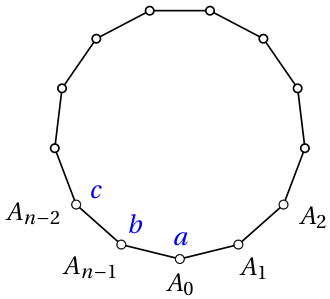
Let the vertices of an -gon be labeled with numbers satisfying the conditions. Let be the least among these numbers. W.l.o.g., assume that contains and the indices of vertices are increasing counterclockwise. Let and be the numbers at vertices and , respectively (Fig. 8). By condition (1), . By the choice of , we must have , whence by condition (1), contains . As by the choice of , the condition (1) also implies that contains . Hence contains by condition (1) and non-negativity of . Since the vertices can be renumerated without changing the direction in such a way that becomes , we can conclude that also contains . Similarly, every third vertex contains .
If the number of vertices is not divisible by 3 then either or must contain and, as we can repeat this argument, also or , respectively, contains . Thus three consecutive vertices contain . Applying the condition (1) to these three vertices, we obtain . But 0 being in two consecutive vertices implies that 0 is in all vertices. Then the sum of all labels is 0, contradicting the condition (2).
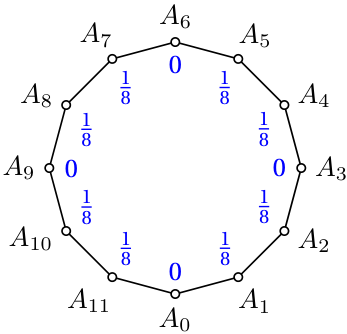
This shows that must be divisible by 3. Let where is a positive integer. For every -gon, the conditions of the problem can be satisfied by writing 0 into every third vertex and into all other vertices (Fig. 9 depicts the situation for ).
If the number of vertices is not divisible by 3 then either or must contain and, as we can repeat this argument, also or , respectively, contains . Thus three consecutive vertices contain . Applying the condition (1) to these three vertices, we obtain . But 0 being in two consecutive vertices implies that 0 is in all vertices. Then the sum of all labels is 0, contradicting the condition (2).
This shows that must be divisible by 3. Let where is a positive integer. For every -gon, the conditions of the problem can be satisfied by writing 0 into every third vertex and into all other vertices (Fig. 9 depicts the situation for ).
Final answer
All integers n that are multiples of three
Techniques
Recurrence relationsColoring schemes, extremal arguments