Browse · MathNet
Print31st Hellenic Mathematical Olympiad
Greece geometry
Problem
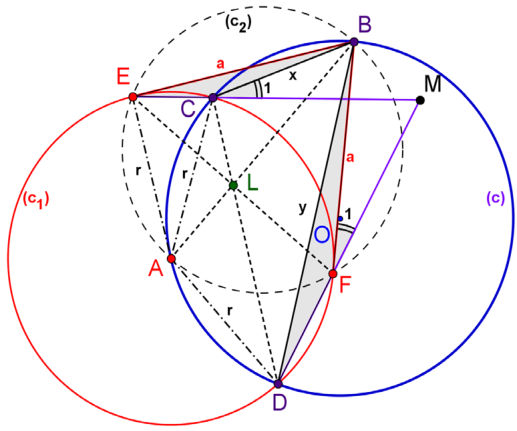
Let be a circle and let be two points on the circle such that . The circle , , meets the circle at points and ( belongs to the small arch ). From point we draw the tangents and to the circle , such that lies outside of the circle . The lines and intersect at . Prove that the quadrilateral is cyclic. (E. Psychas)
Solution
is cyclic ( and are tangents and: ). Let be its circumcircle. The segment is the common chord of the circles () and () and the segment is the common chord of the circles () and (). Finally, is the common chord of the circles () and (). Hence the chords , , pass through the radical center, say , of the three circles.
Since and are tangents of the circle , is the bisector of the angle . Moreover, is the bisector of the angle , because and are inscribed in the circle and correspond to the equal arches and . Hence .
Figure 2
Using equality , we will prove that the triangles and are similar. For that it is enough to prove that: , where , and . Similarly from : and from , we have:
From (1) and (2) we have: (A) and from the orthogonal triangle with the altitude to the hypotenuse we get . (B) From (A) and (B) we obtain: . Therefore . From the equalities of their corresponding angles we find: . Hence the quadrilateral is cyclic.
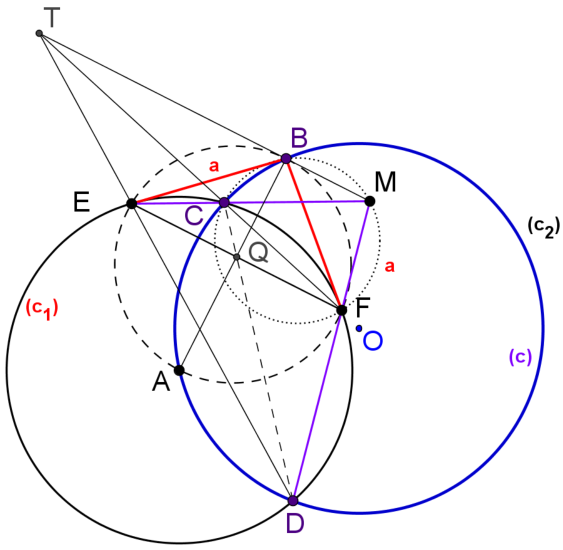
Alternative solution: Let . From Pascal's theorem to degenerate hexagon EEDFFC, if , we get that are collinear. Moreover, in the cyclic quadrilateral ECFD, the points are the common points of its opposite sides and is the common point of its diagonals. Therefore the line TM is the polar of , and so (A is the center of the circle) which means that . Since , we get that . Hence we have:
Figure 3
Since and are tangents of the circle , is the bisector of the angle . Moreover, is the bisector of the angle , because and are inscribed in the circle and correspond to the equal arches and . Hence .
Figure 2
Using equality , we will prove that the triangles and are similar. For that it is enough to prove that: , where , and . Similarly from : and from , we have:
From (1) and (2) we have: (A) and from the orthogonal triangle with the altitude to the hypotenuse we get . (B) From (A) and (B) we obtain: . Therefore . From the equalities of their corresponding angles we find: . Hence the quadrilateral is cyclic.
Alternative solution: Let . From Pascal's theorem to degenerate hexagon EEDFFC, if , we get that are collinear. Moreover, in the cyclic quadrilateral ECFD, the points are the common points of its opposite sides and is the common point of its diagonals. Therefore the line TM is the polar of , and so (A is the center of the circle) which means that . Since , we get that . Hence we have:
Figure 3
Techniques
Radical axis theoremTangentsCyclic quadrilateralsAngle chasingPolar triangles, harmonic conjugates