Browse · MathNet
Print41st Balkan Mathematical Olympiad
geometry
Problem
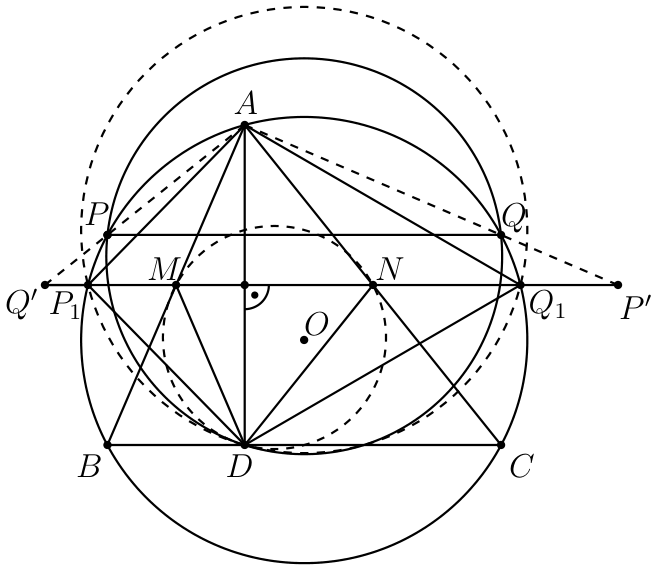
Let be a scalene acute triangle , be the orthogonal projection of on , and are the midpoints of and respectively. Let are points on the minor arcs and of circumcircle of respectively such that . Show that the circumcircles of and are tangent to each other if and only if passes through .
Solution
Consider = the inversion of pole and followed by the reflection with respect to angle bisector of . Denote for any in the plane. Notice that , , the midpoints of and respectively and that Euler's circle of the triangle is , so it's 'inverse' is the circle . But now, , and is the circumcenter of , denoted by : Indeed, the line is sent to the circle , which is the circle with diameter . And since and are isogonals, it follows that . Hence the circle is sent to . At the same time circle is sent to the line . As , it follows that arcs and are equal, so and are isogonals, , and the circle is sent to .
and and then the circles () and () are tangent as they are isosceles with and . Hence () and () are tangent at and . Now () and () are tangent if and only if () and () are tangent, so if and only if the tangent at to () is the tangent at to () which happens if and only if the triangle is isosceles with base which is equivalent to . So we have and also . It follows that But this means that lies on the segment bisector of and respectively. So the minor arcs and are equal and the triangle is isosceles, contradiction. The conclusion follows now.
and and then the circles () and () are tangent as they are isosceles with and . Hence () and () are tangent at and . Now () and () are tangent if and only if () and () are tangent, so if and only if the tangent at to () is the tangent at to () which happens if and only if the triangle is isosceles with base which is equivalent to . So we have and also . It follows that But this means that lies on the segment bisector of and respectively. So the minor arcs and are equal and the triangle is isosceles, contradiction. The conclusion follows now.
Techniques
Triangle centers: centroid, incenter, circumcenter, orthocenter, Euler line, nine-point circleTangentsInversionIsogonal/isotomic conjugates, barycentric coordinatesAngle chasing