Browse · MathNet
PrintIMO Problem Shortlist
geometry
Problem
Let be a circumscribed quadrilateral. Let be a line through which meets the segment in and the line in . Denote by , and the incenters of , , and , respectively. Show that the orthocenter of lies on .
Solution
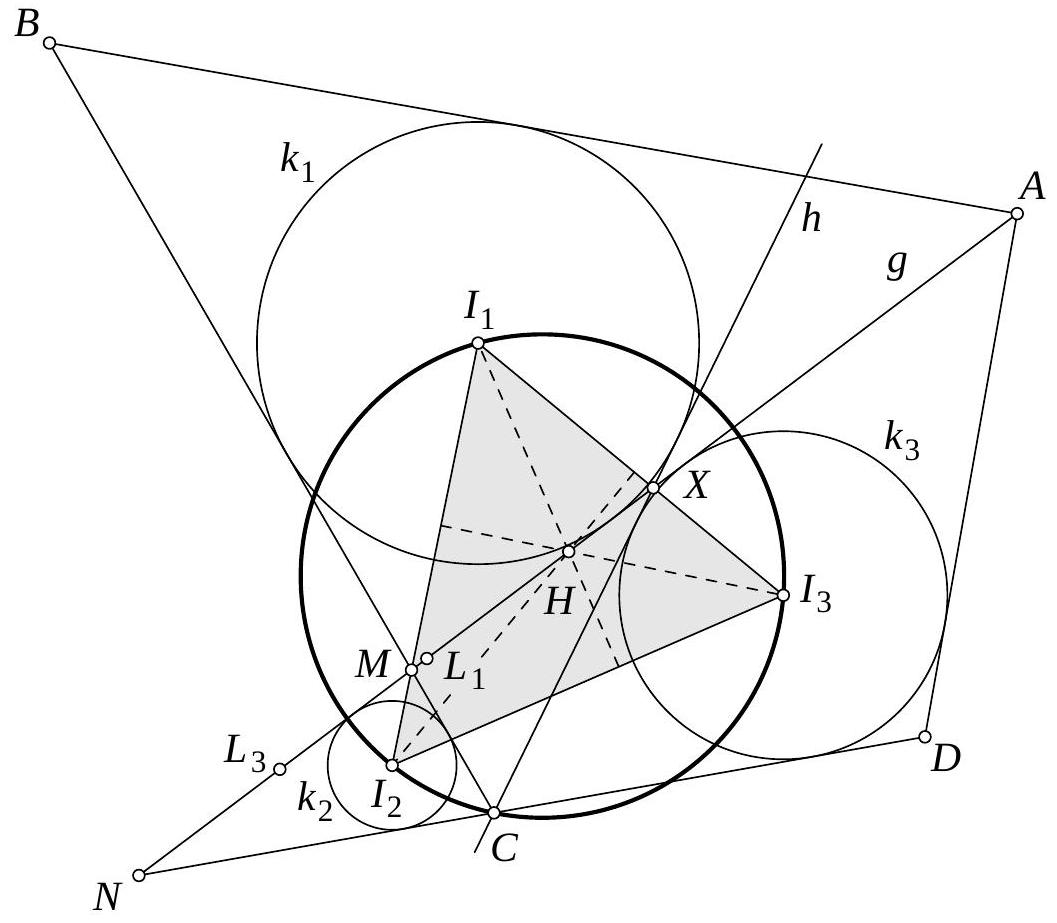
Let and be the incircles of triangles , , and , respectively (see Figure 1). We shall show that the tangent from to which is different from is also tangent to .
Figure 1
To this end, let denote the point of intersection of and . Then and are circumscribed quadrilaterals, whence i.e. which in turn reveals that the quadrilateral is also circumscribed. Thus touches indeed the circle .
Moreover, we find that , from which we conclude that are concyclic.
Let now and be the reflection points of with respect to the lines and respectively. Since is the angle bisector of , it follows that lies on . By analogous reasoning, lies on .
Let be the orthocenter of . We have , which entails that the quadrilateral is cyclic. Analogously, is cyclic.
Then, working with oriented angles modulo , we have whence , and are collinear. By , the claim follows.
---
Alternative solution.
We start by proving that , and are concyclic.
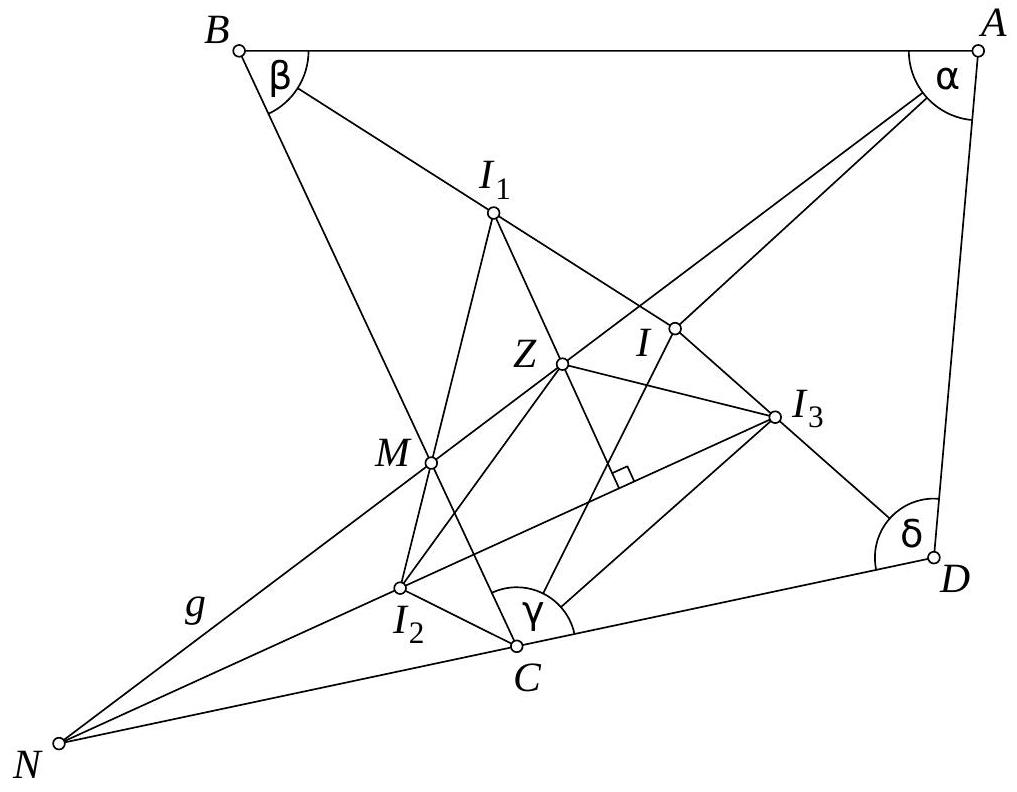
Figure 2
To this end, notice first that are collinear, as are (see Figure 2). Denote by the internal angles of . By considerations in triangle , it follows that . We will show that , too. Denote by the incenter of . Clearly, , , .
Using the abbreviation for the distance from point to the line , we have because of and that Furthermore, consideration of the angle sums in , , and implies , from which we see Because of , , multiplication yields By it follows that which concludes the proof of the above statement.
Let the perpendicular from on intersect at . Then . Since we have also , triangles and are similar. From this one easily proves that also and are similar. Because , and are concyclic, , thus and are similar, hence and are similar. We conclude , hence . This completes the proof.
Figure 1
To this end, let denote the point of intersection of and . Then and are circumscribed quadrilaterals, whence i.e. which in turn reveals that the quadrilateral is also circumscribed. Thus touches indeed the circle .
Moreover, we find that , from which we conclude that are concyclic.
Let now and be the reflection points of with respect to the lines and respectively. Since is the angle bisector of , it follows that lies on . By analogous reasoning, lies on .
Let be the orthocenter of . We have , which entails that the quadrilateral is cyclic. Analogously, is cyclic.
Then, working with oriented angles modulo , we have whence , and are collinear. By , the claim follows.
---
Alternative solution.
We start by proving that , and are concyclic.
Figure 2
To this end, notice first that are collinear, as are (see Figure 2). Denote by the internal angles of . By considerations in triangle , it follows that . We will show that , too. Denote by the incenter of . Clearly, , , .
Using the abbreviation for the distance from point to the line , we have because of and that Furthermore, consideration of the angle sums in , , and implies , from which we see Because of , , multiplication yields By it follows that which concludes the proof of the above statement.
Let the perpendicular from on intersect at . Then . Since we have also , triangles and are similar. From this one easily proves that also and are similar. Because , and are concyclic, , thus and are similar, hence and are similar. We conclude , hence . This completes the proof.
Techniques
Inscribed/circumscribed quadrilateralsTangentsTriangle centers: centroid, incenter, circumcenter, orthocenter, Euler line, nine-point circleAngle chasing