Browse · MathNet
Print12th Czech-Polish-Slovak Mathematics Competition
geometry
Problem
Let be a right triangle with hypotenuse and be a point inside the shorter arc of the circumcircle of the triangle . The line perpendicular to which passes through intersects the lines and in points and respectively. Prove that the ratio of the areas of the triangles and does not depend on the choice of the point .
Solution
Throughout the solution, we shall denote by the area of the triangle .
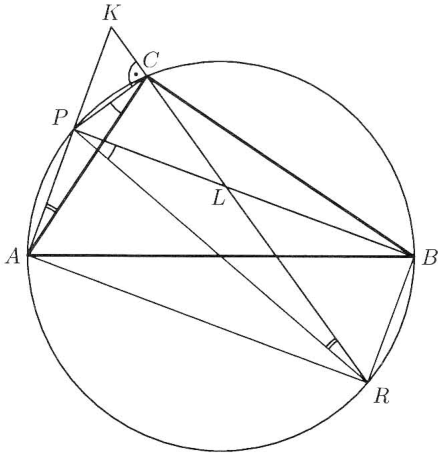
Fig. 3
Let be the diameter of the circumcircle of (Fig. 3). Then is a rectangle. Since is parallel to we have , which implies Since we have . Also, because is cyclic we have . Hence and are similar triangles. Finally, we have which does not depend on the point .
Second solution.
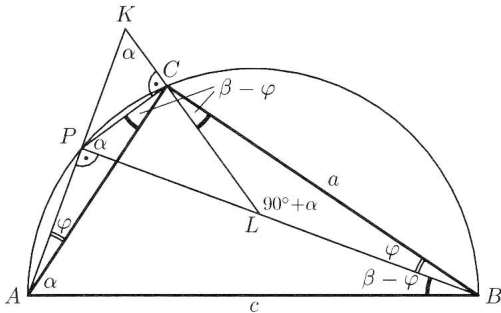
Denote the lengths of the sides and the sizes of the angles of the triangle by , , and , , , respectively (Fig. 4). Let . Simple angle chasing gives , , , , . Also, , .
Fig. 4
Using the sine law in and we get Then
and is clearly independent on the choice of the point .
Remark. We can shorten the previous solution by noticing that from the angles we have a pair of similar triangles , (Fig. 4). Then and the desired ratio can be expressed as $$ \frac{S_{KLB}}{S_{APC}} = \frac{BL \cdot KL}{AP \cdot CP} = \frac{LC \cdot KL}{PC^2}.
Fig. 3
Let be the diameter of the circumcircle of (Fig. 3). Then is a rectangle. Since is parallel to we have , which implies Since we have . Also, because is cyclic we have . Hence and are similar triangles. Finally, we have which does not depend on the point .
Second solution.
Denote the lengths of the sides and the sizes of the angles of the triangle by , , and , , , respectively (Fig. 4). Let . Simple angle chasing gives , , , , . Also, , .
Fig. 4
Using the sine law in and we get Then
and is clearly independent on the choice of the point .
Remark. We can shorten the previous solution by noticing that from the angles we have a pair of similar triangles , (Fig. 4). Then and the desired ratio can be expressed as $$ \frac{S_{KLB}}{S_{APC}} = \frac{BL \cdot KL}{AP \cdot CP} = \frac{LC \cdot KL}{PC^2}.
Techniques
Cyclic quadrilateralsAngle chasingTriangle trigonometry