Browse · MathNet
PrintEstonian Mathematical Olympiad
Estonia counting and probability
Problem
Pieces of cardboard of dimensions are placed on a grid in such a way that each piece covers exactly 4 adjacent unit squares (either horizontally or vertically) and no two pieces touch each other side-to-side, edge-to-edge, or corner-to-corner. Find the largest possible number of cardboard pieces.
Solution
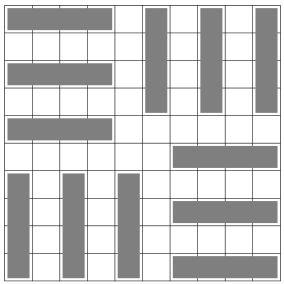
Let the pieces of cardboard be placed on the grid as required. Since each piece covers exactly 4 unit squares and no two pieces touch, there is at least a 1-unit wide space between every two pieces. Therefore, if we draw a half-unit wide "no-go zone" around each piece, the areas covered by the pieces and their no-go zones will have dimensions of and will not overlap. Since these areas extend over the edges of the grid by at most half a unit, all these areas can fit within a square. Therefore, no more than pieces can be placed on the grid. This limit case is achievable, as shown in Fig. 37.
Fig. 37
---
Alternative solution.
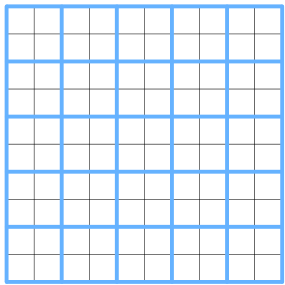
Divide the grid into squares of dimensions (Fig. 38).
Note that at most 2 unit squares can be covered in any square because otherwise at least two different pieces must be used which would then touch each other. Since there are 25 squares of , the pieces can cover at most unit squares, and thus there can be at most pieces. The fact that 12 pieces are possible is shown in Fig. 37.
Fig. 38
Fig. 37
---
Alternative solution.
Divide the grid into squares of dimensions (Fig. 38).
Note that at most 2 unit squares can be covered in any square because otherwise at least two different pieces must be used which would then touch each other. Since there are 25 squares of , the pieces can cover at most unit squares, and thus there can be at most pieces. The fact that 12 pieces are possible is shown in Fig. 37.
Fig. 38
Final answer
12
Techniques
Coloring schemes, extremal argumentsOptimization in geometry