Browse · MathNet
PrintSelection Examination A
Greece geometry
Problem
In the plane there are given different circles with the same center. In the interior of the circle with the smaller radius we consider two different points and . Next we consider different lines passing from point and different lines passing from point . All lines passing from intersect all lines passing from (there is no line passing from and ) and their points of intersection are not on the given circles. Determine the maximal and the minimal number of regions bounded by the lines and the circles, lying in the interior of the circles and for the regions lying into the smaller circle at least one part of their border is an arch of the circle.
Solution
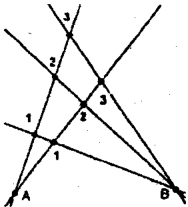
First we note that the number of points of intersection of the lines is (figure 1).
Figure 1
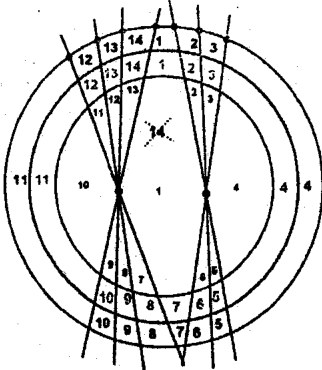
Let now all the points of intersection lie at the exterior of the circle with the greatest radius. Then the different lines passing through create regions inside the circle with the smaller radius, while the different lines passing through create regions inside the circle with the smaller radius. Since we have counted the shaded region (figure 2) two times, the total number of regions inside the smaller circle is .
We have totally circular rings. In each circular ring is created the same number of regions , but the shaded region is divided in two regions (figures 2α and 2β). Therefore inside any circular ring we have regions.
figure 2β
figure 2α
Finally in this case the total number of regions is: .
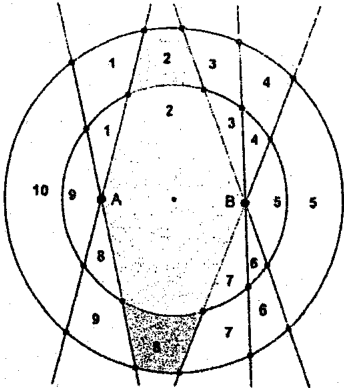
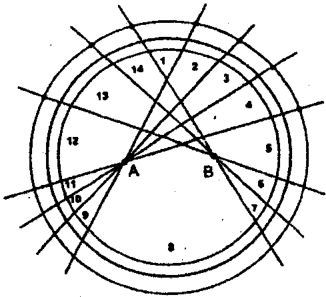
If one or more points of intersection lie inside the circle with the smaller radius, then we have regions inside the smaller circle (figures 3α, 3β και 3γ). In the case of figure 3α (all the points of intersection lie inside the circle with the smaller radius) we have regions into the circular rings. In the case one point of intersection lie into a circular ring the number of region increases by one. Therefore, finally we have totally
figure 3α
Figure 1
Let now all the points of intersection lie at the exterior of the circle with the greatest radius. Then the different lines passing through create regions inside the circle with the smaller radius, while the different lines passing through create regions inside the circle with the smaller radius. Since we have counted the shaded region (figure 2) two times, the total number of regions inside the smaller circle is .
We have totally circular rings. In each circular ring is created the same number of regions , but the shaded region is divided in two regions (figures 2α and 2β). Therefore inside any circular ring we have regions.
figure 2β
figure 2α
Finally in this case the total number of regions is: .
If one or more points of intersection lie inside the circle with the smaller radius, then we have regions inside the smaller circle (figures 3α, 3β και 3γ). In the case of figure 3α (all the points of intersection lie inside the circle with the smaller radius) we have regions into the circular rings. In the case one point of intersection lie into a circular ring the number of region increases by one. Therefore, finally we have totally
figure 3α
Final answer
minimum = 2n(k+m) − 1; maximum = 2n(k+m)
Techniques
Constructions and lociColoring schemes, extremal arguments