Browse · MathNet
Print69th Belarusian Mathematical Olympiad
Belarus geometry
Problem
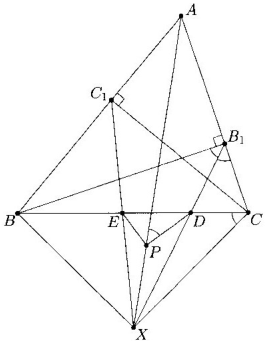
The altitudes and are drawn in the acute triangle . The bisectors of angles and intersect the line at points and respectively and meet each other at point . Prove that the intersection points of circumcircles of the triangles and lie on the line .
Solution
Since , the points and lie on the circle with the diameter . Hence the bisectors of angles and pass through the midpoint of the arc of , so this midpoint is .
First we prove that the quadrilateral is cyclic. The angle is an external angle of the triangle , hence . Since is right, . Thus, Now we prove that the intersection points of the circumcircles of the triangles and lie on the line . Let the circumcircle of the triangle intersect the line at points and , then . Since points and are concyclic, . Hence , and therefore the circumcircle of the triangle passes through .
Finally, we will prove that the circumcircles of the triangles and passes through points and . Since point is the midpoint of the arc , and . Therefore, . Since the quadrilateral is cyclic, . Hence , i.e. points and are concyclic. Similarly, the quadrilateral is cyclic. If point is distinct from point , the problem is solved. If points and coincide, the equalities and imply that the circumcircles of the triangles and are tangent to the line .
---
Alternative solution.
Note that is concyclic, and let and be the circumcircles of , , and , respectively. Since and are the bisectors of and , they both pass through the midpoint of the arc of not containing and , thus this midpoint is . Let intersect and the second time at points and , respectively, and denote .
As in the first solution, note that is cyclic. Let , and be the circumcircles of , , and , respectively. Since and are radical axes of and and , the radical axis of passes through . On the other hand, it passes through since . Thus, is the radical axis of , and it follows from that Consequently, and the problem is solved.
First we prove that the quadrilateral is cyclic. The angle is an external angle of the triangle , hence . Since is right, . Thus, Now we prove that the intersection points of the circumcircles of the triangles and lie on the line . Let the circumcircle of the triangle intersect the line at points and , then . Since points and are concyclic, . Hence , and therefore the circumcircle of the triangle passes through .
Finally, we will prove that the circumcircles of the triangles and passes through points and . Since point is the midpoint of the arc , and . Therefore, . Since the quadrilateral is cyclic, . Hence , i.e. points and are concyclic. Similarly, the quadrilateral is cyclic. If point is distinct from point , the problem is solved. If points and coincide, the equalities and imply that the circumcircles of the triangles and are tangent to the line .
---
Alternative solution.
Note that is concyclic, and let and be the circumcircles of , , and , respectively. Since and are the bisectors of and , they both pass through the midpoint of the arc of not containing and , thus this midpoint is . Let intersect and the second time at points and , respectively, and denote .
As in the first solution, note that is cyclic. Let , and be the circumcircles of , , and , respectively. Since and are radical axes of and and , the radical axis of passes through . On the other hand, it passes through since . Thus, is the radical axis of , and it follows from that Consequently, and the problem is solved.
Techniques
Radical axis theoremCoaxal circlesCyclic quadrilateralsAngle chasingTangents