Browse · MathNet
Print31st Turkish Mathematical Olympiad
Turkey geometry
Problem
Let be a triangle. Let , , be points on the sides , , respectively, such that The circumcircle of the triangle meets at again and meets the line passing through and tangent to the circumcircle of the triangle at again. Let the line intersect at and at . Prove that bisects if and only if bisects .
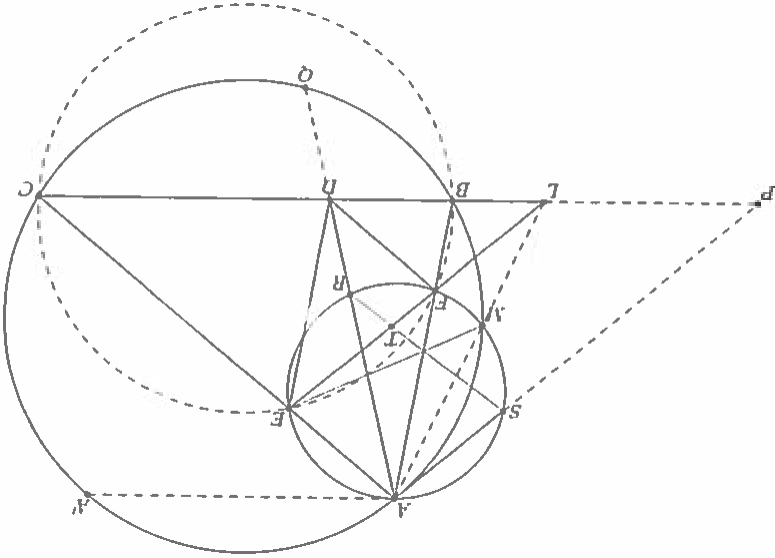
Solution
From the condition we know that is the -symmedian of the triangle . Let be the side lengths of the triangle, then we get hence and similarly . Using these we get hence are concyclic. Let the circumcircle of the triangle be and let the circumcircle of the triangle be . Let meet for the second time at and let . Let the intersection of and other than be . The radical axis of the circles , and are concurrent, let this point be . Let the line passing through and parallel to intersect for the second time at . Since we find that and are tangent to each other.
Let us consider the spiral similarity centred at and satisfying . It is in fact the spiral similarity that sends the circle to the circle , thus also satisfies and . Since is a symmedian, the tangent lines to passing through and intersect on the line . Therefore, under , the tangent lines to passing through and intersect on the line . In addition, simple angle chasing gives that and which means hence, circumcircle of the triangle and the line are tangent to each other. From here we find , also since we know we obtain that is the midpoint of the segment . We found that the lines and are parallel, therefore we have and projecting these lines to we find that , which means the tangent lines to passing through intersect on the line . In this case, this intersection point was also on the line , it must be .
So, we find that the polar line of with respect to is , and since , from Brokard's Theorem in quadrilateral , the lines and intersect on the polar line . Hence , , are concurrent, and we also have . Furthermore, on the circle we have and under its image is , hence the points are collinear. Let , then we obtain . Finally, by definition we have and under it becomes
Now, we will work on the problem statement to finish the solution. We will prove that both conditions are equivalent to or . Solution to both cases are identical, thus we only study the case where . First, we know that and under we have . Also, we have . is equivalent to the following statements: From the first condition, bisecting is equivalent to . From the concurrency we find that bisecting is equivalent to bisecting . bisecting is equivalent to the condition , and reflecting these lines to the line shows that it is in fact equivalent to being collinear. From the second condition this is equivalent to hence the required statement is proven.
Let us consider the spiral similarity centred at and satisfying . It is in fact the spiral similarity that sends the circle to the circle , thus also satisfies and . Since is a symmedian, the tangent lines to passing through and intersect on the line . Therefore, under , the tangent lines to passing through and intersect on the line . In addition, simple angle chasing gives that and which means hence, circumcircle of the triangle and the line are tangent to each other. From here we find , also since we know we obtain that is the midpoint of the segment . We found that the lines and are parallel, therefore we have and projecting these lines to we find that , which means the tangent lines to passing through intersect on the line . In this case, this intersection point was also on the line , it must be .
So, we find that the polar line of with respect to is , and since , from Brokard's Theorem in quadrilateral , the lines and intersect on the polar line . Hence , , are concurrent, and we also have . Furthermore, on the circle we have and under its image is , hence the points are collinear. Let , then we obtain . Finally, by definition we have and under it becomes
Now, we will work on the problem statement to finish the solution. We will prove that both conditions are equivalent to or . Solution to both cases are identical, thus we only study the case where . First, we know that and under we have . Also, we have . is equivalent to the following statements: From the first condition, bisecting is equivalent to . From the concurrency we find that bisecting is equivalent to bisecting . bisecting is equivalent to the condition , and reflecting these lines to the line shows that it is in fact equivalent to being collinear. From the second condition this is equivalent to hence the required statement is proven.
Techniques
Brocard point, symmediansSpiral similarityTangentsRadical axis theoremPolar triangles, harmonic conjugatesAngle chasing