Browse · MathNet
PrintBalkan Mathematical Olympiad
geometry
Problem
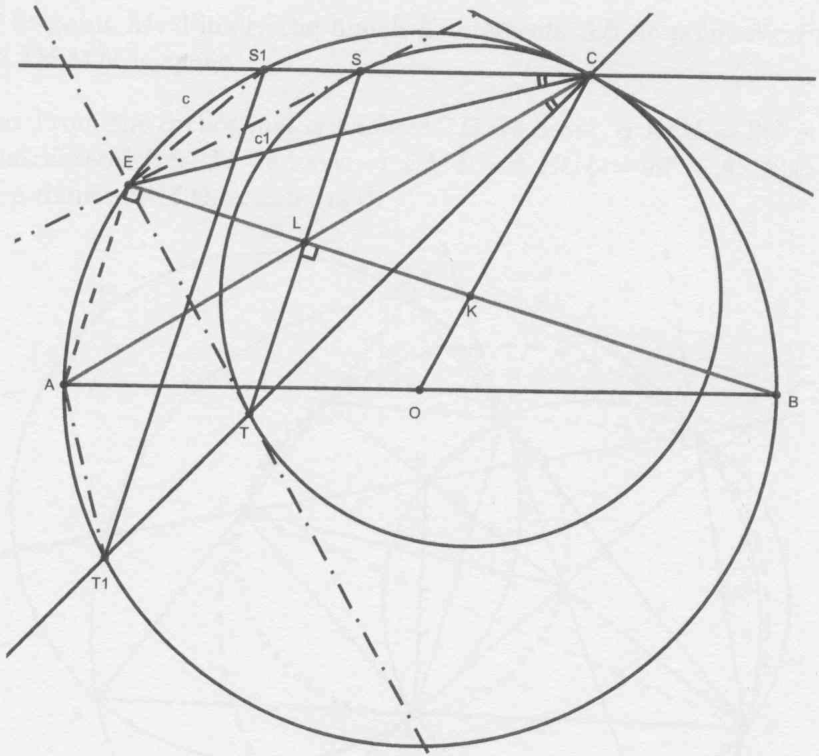
Let be a circle, a diameter and an arbitrary point different than and such that . On the radius we consider point and the circle . The extension of the segment meets the circle () at point . From we consider the tangents and to the circle (). Prove that the lines and are concurrent.
Solution
Let the lines and intersect at point . It is enough to prove that passes through , that is, the points are collinear (Figure 1).
We observe that the circles and are homothetic with respect to homothety , that is, homothety with center and ratio Then the extension of meets the circle () at a point homothetic to with respect to . The extension of meets the circle () at a point homothetic to with respect to . Therefore the segment is homothetic to the segment and hence (1)
Since and are tangents to the circle (), is the perpendicular bisector of the segment . Hence is the midpoint of .
Moreover, , and hence . Since is the perpendicular bisector of , we have that: (2)
From relations (1) and (2) we conclude that the quadrilateral is isosceles trapezium and hence and thus . (3)
Since and are tangents of the circumcircle of the triangle (at , ), is the symmedian corresponding to the vertex . From relations (3) and (4) we conclude that the points are collinear.
We observe that the circles and are homothetic with respect to homothety , that is, homothety with center and ratio Then the extension of meets the circle () at a point homothetic to with respect to . The extension of meets the circle () at a point homothetic to with respect to . Therefore the segment is homothetic to the segment and hence (1)
Since and are tangents to the circle (), is the perpendicular bisector of the segment . Hence is the midpoint of .
Moreover, , and hence . Since is the perpendicular bisector of , we have that: (2)
From relations (1) and (2) we conclude that the quadrilateral is isosceles trapezium and hence and thus . (3)
Since and are tangents of the circumcircle of the triangle (at , ), is the symmedian corresponding to the vertex . From relations (3) and (4) we conclude that the points are collinear.
Techniques
TangentsHomothetyBrocard point, symmediansAngle chasing