Browse · MathNet
Print6-th Czech-Slovak Match
Czech Republic geometry
Problem
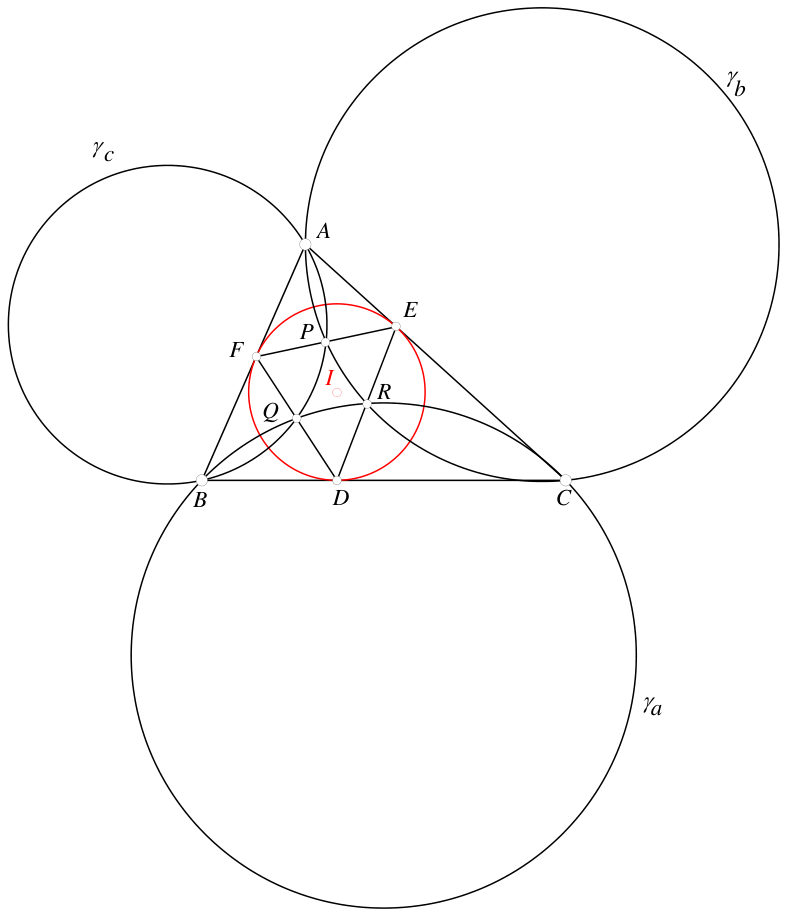
Let be a triangle, its incircle and three circles orthogonal to passing through and , and , and and respectively. The circles meet again in ; in the same way we obtain the points and . Prove that the radius of the circumcircle of is half the radius of .
Solution
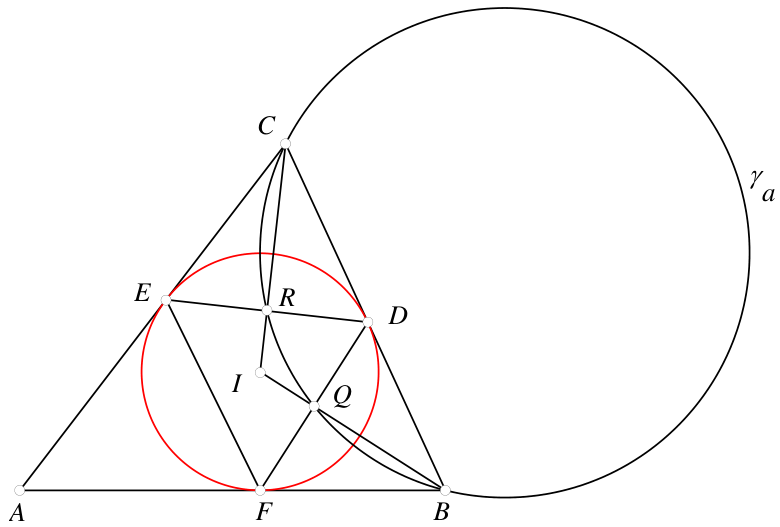
Let and denote the center and the radius of circle . Let , and denote the points where touches , and , respectively. Let , and denote the midpoints of , and respectively. We will use the well known lemma: LEMMA. The circles to and to are orthogonal if and only if First of all we prove that point and lie on circle . Obviously is a deltoid, so is the foot of a perpendicular from point to . Thus, applying the first Euclidean's theorem to triangle , we have . Similarly . Thus , so the points lie on a circle which we denote . The points and , so that point lies outside the circle . By the above relations, we obtain that the power of the point to the circle is , which means that the circles and are orthogonal. From the uniqueness of it follows that . Thus contains and . Similarly contains and and contains and . Hence, , and . Therefore the radius of the circumcircle of is half the radius of . ☐
Let be the incircle of . Let , and denote the points where touches , and , respectively. Let , and denote the midpoints of , and respectively. We prove that passes through and . Since and , we obtain . We conclude that , and lie on a single circle . Moreover, since the power of with respect to is , it follows for a tangent from to that lies on and hence is perpendicular to . From the uniqueness of it follows that . Thus contains and . Similarly contains and and contains and . Hence, and . Therefore the radius of the circumcircle of is half the radius of .
Let be the incircle of . Let , and denote the points where touches , and , respectively. Let , and denote the midpoints of , and respectively. We prove that passes through and . Since and , we obtain . We conclude that , and lie on a single circle . Moreover, since the power of with respect to is , it follows for a tangent from to that lies on and hence is perpendicular to . From the uniqueness of it follows that . Thus contains and . Similarly contains and and contains and . Hence, and . Therefore the radius of the circumcircle of is half the radius of .
Techniques
Triangle centers: centroid, incenter, circumcenter, orthocenter, Euler line, nine-point circleTangentsRadical axis theorem