Browse · MathNet
PrintTHE 68th NMO SELECTION TESTS FOR THE JUNIOR BALKAN MATHEMATICAL OLYMPIAD
Romania geometry
Problem
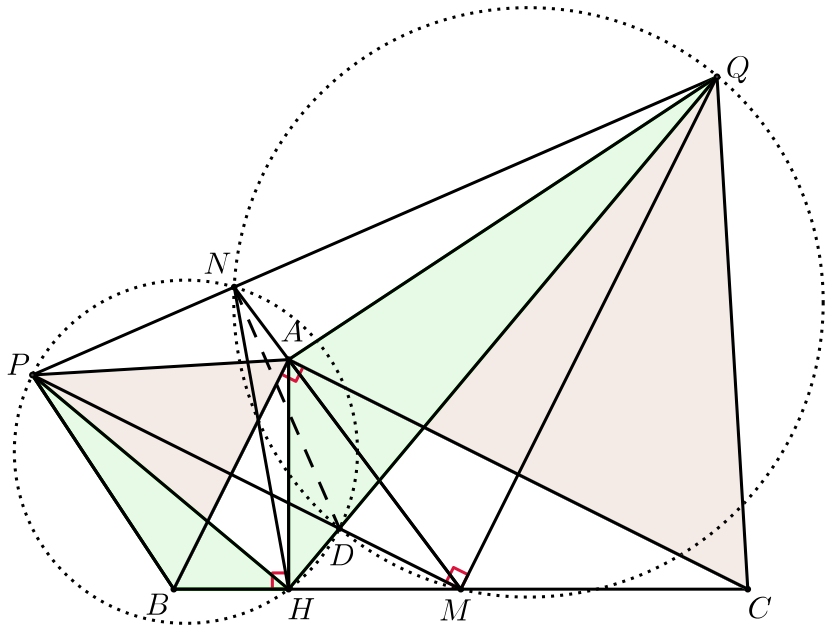
Let be a right triangle, with the right angle at . The altitude from meets at and is the midpoint of the hypotenuse . On the legs, in the exterior of the triangle, equilateral triangles and are constructed. If is the intersection point of the lines and , prove that the angles and are equal.
Miguel Ochoa Sanchez, Peru, and Leonard Giugiuc
Miguel Ochoa Sanchez, Peru, and Leonard Giugiuc
Solution
If , the statement is obvious. In the following, we assume , the other case being similar.
Triangles and are congruent (SSS), hence . Similarly, , and this leads rapidly to .
As and , triangles and are similar (SAS).
It follows that , hence .
In conclusion, the points and are co-cyclic, hence .
Let . The angle is exterior to the triangle , therefore . (1)
It follows that the quadrilateral is cyclic, hence . This means that is also cyclic, therefore . (2)
From (1) and (2) it follows that , i.e. ( is the bisector of angle ). For the triangle ray ( is the external bisector, while ( is an internal bisector, which means that is the excenter opposite to the vertex ). Then ( is the internal bisector of angle .
Finally, .
---
Alternative solution.
(given in the contest by Paul Bécsi*)
Let . An easy computation shows that , which shows that the rays ( and ( are isogonal in the angle ). From Steiner's Theorem it follows that .
The conclusion means the rays ( and ( are isogonal in the angle , which, according to Steiner's Theorem, is equivalent to .
In conclusion, we need to prove that .
But leads to . As , it follows that , i.e., and the conclusion.
Triangles and are congruent (SSS), hence . Similarly, , and this leads rapidly to .
As and , triangles and are similar (SAS).
It follows that , hence .
In conclusion, the points and are co-cyclic, hence .
Let . The angle is exterior to the triangle , therefore . (1)
It follows that the quadrilateral is cyclic, hence . This means that is also cyclic, therefore . (2)
From (1) and (2) it follows that , i.e. ( is the bisector of angle ). For the triangle ray ( is the external bisector, while ( is an internal bisector, which means that is the excenter opposite to the vertex ). Then ( is the internal bisector of angle .
Finally, .
---
Alternative solution.
(given in the contest by Paul Bécsi*)
Let . An easy computation shows that , which shows that the rays ( and ( are isogonal in the angle ). From Steiner's Theorem it follows that .
The conclusion means the rays ( and ( are isogonal in the angle , which, according to Steiner's Theorem, is equivalent to .
In conclusion, we need to prove that .
But leads to . As , it follows that , i.e., and the conclusion.
Techniques
Cyclic quadrilateralsIsogonal/isotomic conjugates, barycentric coordinatesBrocard point, symmediansAngle chasingTriangle centers: centroid, incenter, circumcenter, orthocenter, Euler line, nine-point circle