Browse · MathNet
PrintVN IMO Booklet
Vietnam counting and probability
Problem
A farmer has 2 rectangle lands of size .
a. On the first land, there are 9 circle gardens of diameter . Prove that regardless to the position of gardens, he always can builds a rectangle garden of size .
b. On the second land, he builds a convex polygon lake such that the shortest distance from any point on the boundary of the land to the lake is at most m. Prove that the perimeter of the lake is at least m.
a. On the first land, there are 9 circle gardens of diameter . Prove that regardless to the position of gardens, he always can builds a rectangle garden of size .
b. On the second land, he builds a convex polygon lake such that the shortest distance from any point on the boundary of the land to the lake is at most m. Prove that the perimeter of the lake is at least m.
Solution
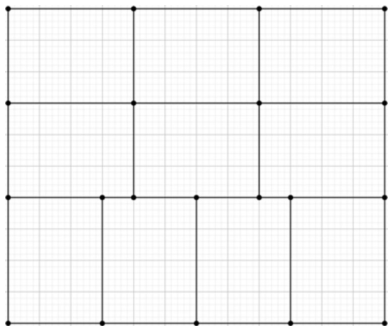
a. Consider the rectangle with and . Divide it into 10 subrectangles of size as follows.
Consider 9 centers of the given gardens. By the pigeonhole principle, there is some subrectangle that does not contain any point among them. Suppose it is the rectangle with , . Consider one more rectangle lying inside such that the sides of the two rectangles are pairwise parallel and the gap equals , then has the size . It is clear that the rectangle does not share any point with any garden, so the desired result will follow.
b. Consider the rectangle with and . Let be the boundary of the lake. From the given hypothesis, there are four points lying on such that Since the lake is a convex polygon, then do not overlap. Hence, the length of is at least Denote as the projection of to , as the projection of to , and similarly define the points . We have By the same way, we get These imply that Finally, by applying Cauchy-Schwarz's inequality, we have Similarly, we also have , , .
From these inequalities, it is clear to conclude that the length of does not exceed .
Consider 9 centers of the given gardens. By the pigeonhole principle, there is some subrectangle that does not contain any point among them. Suppose it is the rectangle with , . Consider one more rectangle lying inside such that the sides of the two rectangles are pairwise parallel and the gap equals , then has the size . It is clear that the rectangle does not share any point with any garden, so the desired result will follow.
b. Consider the rectangle with and . Let be the boundary of the lake. From the given hypothesis, there are four points lying on such that Since the lake is a convex polygon, then do not overlap. Hence, the length of is at least Denote as the projection of to , as the projection of to , and similarly define the points . We have By the same way, we get These imply that Finally, by applying Cauchy-Schwarz's inequality, we have Similarly, we also have , , .
From these inequalities, it is clear to conclude that the length of does not exceed .
Techniques
Pigeonhole principleConstructions and lociDistance chasingCauchy-Schwarz