Browse · MATH
Printjmc
geometry senior
Problem
A semi-circle of radius 8 cm, rocks back and forth along a line. The distance between the line on which the semi-circle sits and the line above is 12 cm. As it rocks without slipping, the semi-circle touches the line above at two points. (When the semi-circle hits the line above, it immediately rocks back in the other direction.) What is the distance between these two points, in millimetres, rounded off to the nearest whole number? 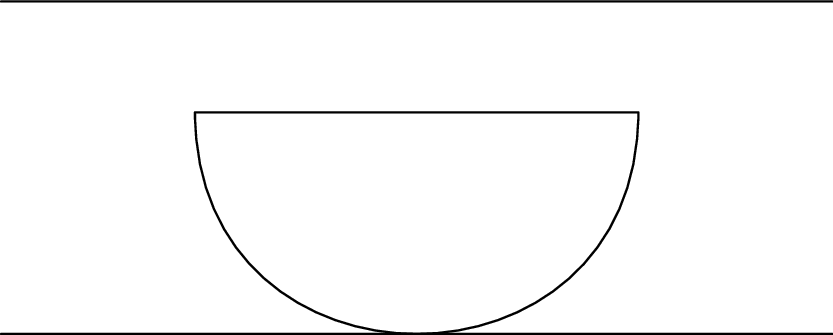 (Note: After finding the exact value of the desired distance, you may find a calculator useful to round this value off to the nearest whole number.)
Solution
In its initial position, suppose the semi-circle touches the bottom line at , with point directly above on the top line. Consider when the semi-circle rocks to the right. Suppose now the semi-circle touches the bottom line at (with the point on the top of the semi-circle directly above , and the point on the top line directly above ) and touches the top line at . Note that .
is one of the desired points where the semi-circle touches the line above. Because the diagram is symmetrical, the other point will be the mirror image of in line . Thus, the required distance is 2 times the length of .
Now . Since the semi-circle is tangent to the bottom line, and is perpendicular to the bottom line and lies on a diameter, we know that is the centre of the circle. So cm, since both are radii (or since the centre always lies on a line parallel to the bottom line and a distance of the radius away).
Also, cm, since the distance between the two lines is 12 cm. By the Pythagorean Theorem (since ), then so cm.
Also, since , then .
Thus, the angle from to the horizontal is , so the semi-circle has rocked through an angle of , ie. has rocked through of a full revolution (if it was a full circle). Thus, the distance of from is of the circumference of what would be the full circle of radius 8, or cm. (We can think of a wheel turning through and the related horizontal distance through which it travels.)
Thus, cm.
Therefore, the required distance is double this, or cm or about 5.4788 cm, which is closest to mm.
is one of the desired points where the semi-circle touches the line above. Because the diagram is symmetrical, the other point will be the mirror image of in line . Thus, the required distance is 2 times the length of .
Now . Since the semi-circle is tangent to the bottom line, and is perpendicular to the bottom line and lies on a diameter, we know that is the centre of the circle. So cm, since both are radii (or since the centre always lies on a line parallel to the bottom line and a distance of the radius away).
Also, cm, since the distance between the two lines is 12 cm. By the Pythagorean Theorem (since ), then so cm.
Also, since , then .
Thus, the angle from to the horizontal is , so the semi-circle has rocked through an angle of , ie. has rocked through of a full revolution (if it was a full circle). Thus, the distance of from is of the circumference of what would be the full circle of radius 8, or cm. (We can think of a wheel turning through and the related horizontal distance through which it travels.)
Thus, cm.
Therefore, the required distance is double this, or cm or about 5.4788 cm, which is closest to mm.
Final answer
55