Browse · MathNet
Print2015 Thirteenth IMAR Mathematical Competition
Romania 2015 geometry
Problem
Let be a triangle, let , , be the antipodes of the vertices , , , respectively, in the circle , and let be a point in the plane , collinear with no two vertices of the triangle . The line through , perpendicular to the line , and the line through , perpendicular to the line , meet at ; the points and are defined similarly. Show that the lines , and are concurrent.
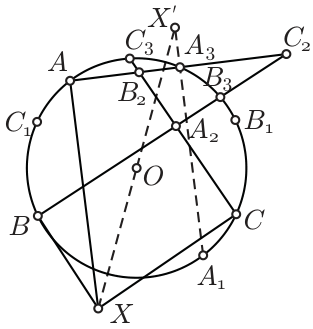
Solution
Let the lines , , meet the circle again at , , , respectively. The angle is a right angle, so is perpendicular to and hence parallel to , and the parallel lines and are equidistant from the circumcentre of the triangle . Hence passes through the reflection of across .
Similarly, the lines and pass through , and therefore , a quantity denoted .
It follows that , , are the poles of the lines , , , respectively, relative to the circle of radius centered at , so the triangles and are in perspective, by the well-known lemma below.
Lemma. If is a triangle, and , , are the poles of the lines , , , respectively, relative to a conic , then the triangles and are in perspective.
Similarly, the lines and pass through , and therefore , a quantity denoted .
It follows that , , are the poles of the lines , , , respectively, relative to the circle of radius centered at , so the triangles and are in perspective, by the well-known lemma below.
Lemma. If is a triangle, and , , are the poles of the lines , , , respectively, relative to a conic , then the triangles and are in perspective.
Techniques
Polar triangles, harmonic conjugatesRotationAngle chasingTangents