Browse · MathNet
PrintSecond Round
Netherlands geometry
Problem
Three consecutive vertices , , and of a regular octagon (8-gon) are the centres of circles that pass through neighbouring vertices of the octagon. The intersection points , , and of the three circles form a triangle (see figure). 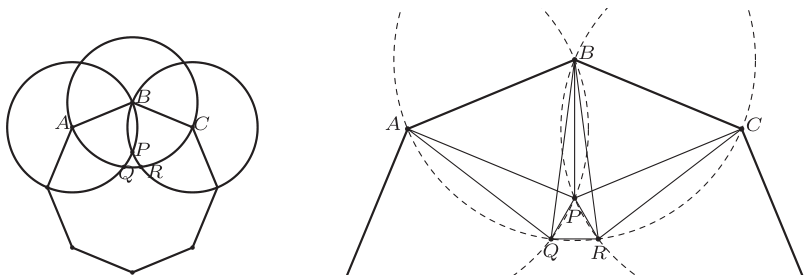 Prove that triangle is equilateral.
Solution
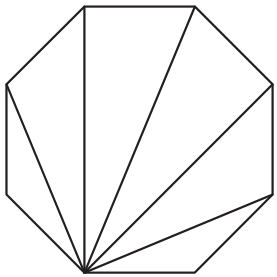
An octagon can be subdivided into six triangles (see figure on the left). Together, the angles of those six triangles add up to the same number of degrees as the eight angles of the octagon. Since the angles of any triangle add up to degrees, this means that the eight angles of the octagon add up to . Hence, each of the angles of the regular octagon is .
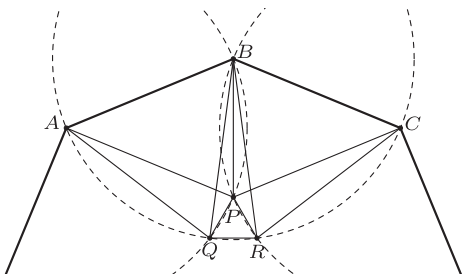
We now consider the figure from the problem statement (see figure on the right). Line segment bisects angle , so . Since triangles and are isosceles (as and ), we also have and .
In triangles and all sides have the same length. These triangles are therefore equilateral and all angles are . From this, we deduce that . In the same way, we find . Furthermore, triangles and are isosceles (since and ), so and .
By mirror symmetry, and have the same length, so is an isosceles triangle with apex . We have already determined all angles at , except . We deduce that From this and the fact that is isosceles, we directly conclude that is equilateral.
We now consider the figure from the problem statement (see figure on the right). Line segment bisects angle , so . Since triangles and are isosceles (as and ), we also have and .
In triangles and all sides have the same length. These triangles are therefore equilateral and all angles are . From this, we deduce that . In the same way, we find . Furthermore, triangles and are isosceles (since and ), so and .
By mirror symmetry, and have the same length, so is an isosceles triangle with apex . We have already determined all angles at , except . We deduce that From this and the fact that is isosceles, we directly conclude that is equilateral.
Techniques
Angle chasing