Browse · MathNet
PrintIMO 2019 Shortlisted Problems
2019 geometry
Problem
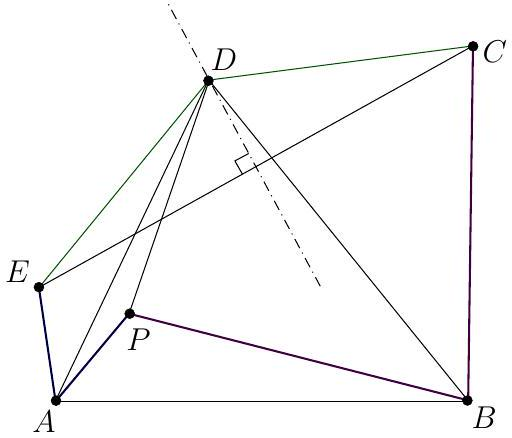
Let be a convex pentagon with and . Suppose that a point is located in the interior of the pentagon such that and . Prove that lies on the diagonal if and only if .
Solution
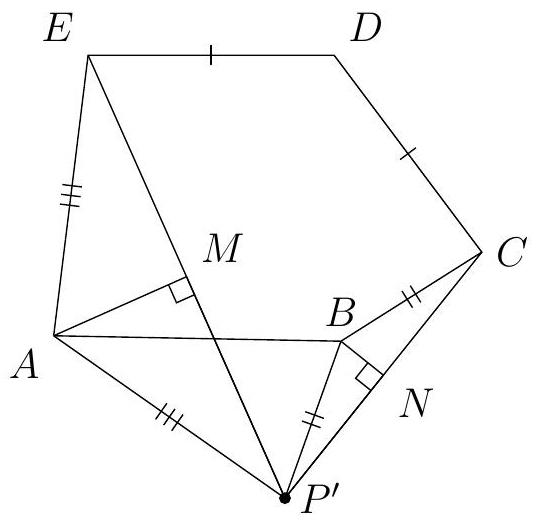
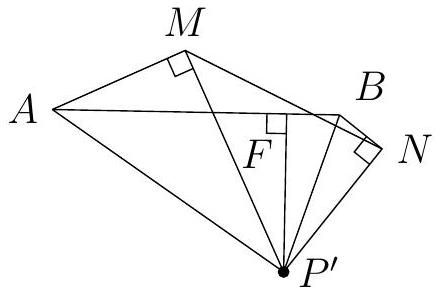
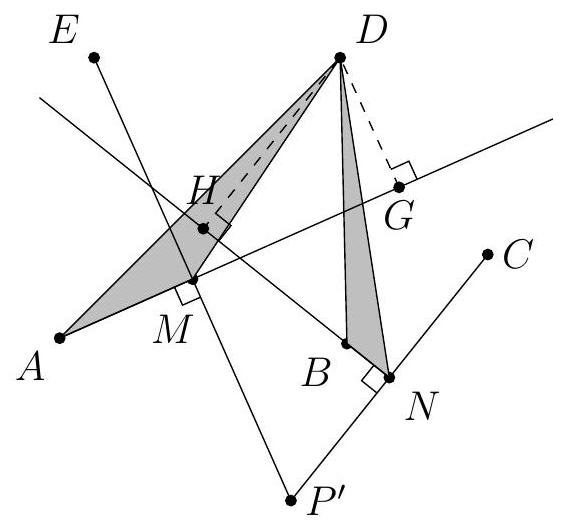
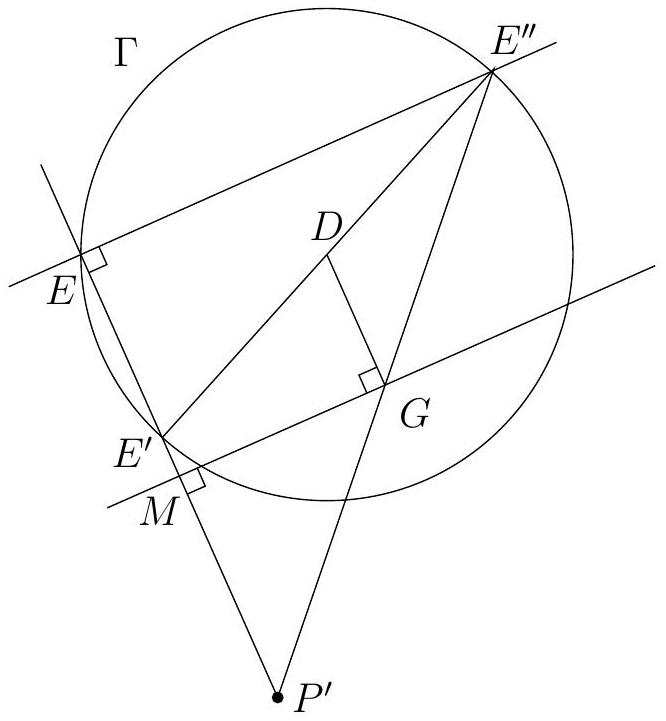
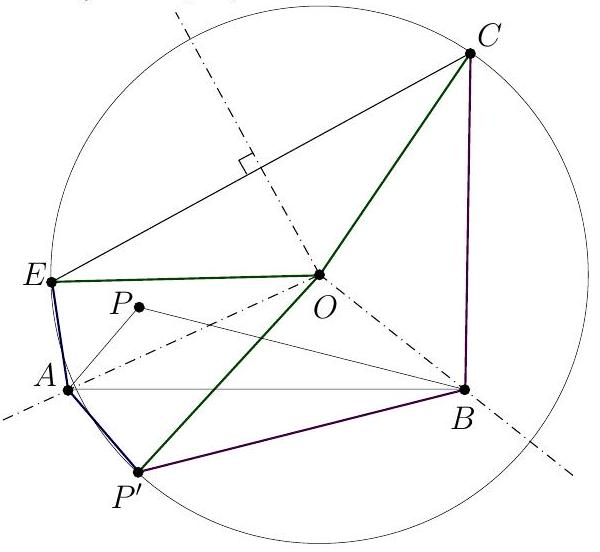
For the equivalence with the collinearity condition, let denote the foot of the perpendicular from to , so that is the midpoint of . We have that lies on if and only if lies on , which occurs if and only if we have the equality of signed angles modulo . By concyclicity of and , this is equivalent to , which occurs if and only if and are directly similar. For the other equivalence with the area condition, we have the equality of signed areas . Using the identity , and similarly for , we find that the area condition is equivalent to the equality Now note that and lie on the perpendicular bisectors of and , respectively. If we write and for the feet of the perpendiculars from to these perpendicular bisectors respectively, then this area condition can be rewritten as (In this condition, we interpret all lengths as signed lengths according to suitable conventions: for instance, we orient from to , orient the parallel line in the same direction, and orient the perpendicular bisector of at an angle clockwise from the oriented segment - we adopt the analogous conventions at .) To relate the signed lengths and to the triangles and , we use the following calculation. Claim. Let denote the circle centred on with both and on the circumference, and the power of with respect to . Then we have the equality Proof. Firstly, we have , since otherwise would lie on , and hence the internal angle bisectors of and would pass through and respectively. This would violate the angle inequality given in the question. Next, let denote the second point of intersection of with , and let denote the point on diametrically opposite , so that is perpendicular to . The point lies on the perpendicular bisectors of the sides and of the right-angled triangle ; it follows that is the midpoint of . Since is the midpoint of , we have that . Since , we have . The other equality follows by exactly the same argument. From this claim, we see that the area condition is equivalent to the equality of ratios of signed lengths, which is equivalent to direct similarity of and , as desired.
---
Alternative solution.
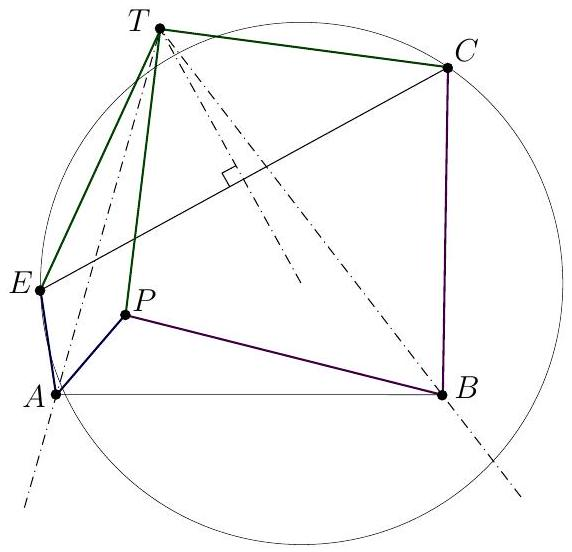
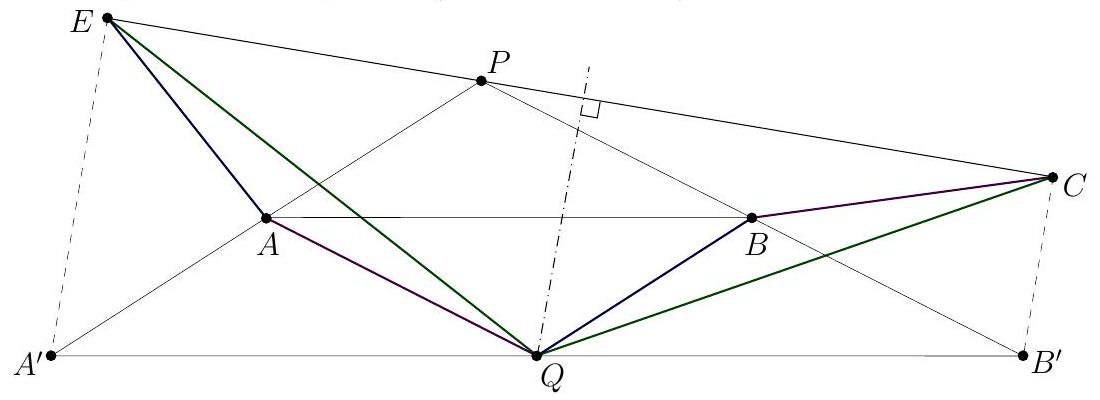
Along the perpendicular bisector of , define the linear function where, from now on, we always use signed areas. Thus, we want to show that are collinear if and only if . Let be the reflection of across line . The point does not lie on the line . To see this, we let and be the points obtained from and by dilating with scale factor 2 about , so that is the orthogonal projection of onto . Since lies on the perpendicular bisector of , the triangle is right-angled at (and similarly). If were to lie on , then the lines and would be perpendicular to and and would lie on the opposite side of to . It follows that the line does not meet triangle , and hence point does not lie inside . But then must lie inside , and it is clear that such a point cannot reflect to a point on . We thus let be the centre of the circle . The lines and are the perpendicular bisectors of and , respectively, so and hence . Notice that if point coincides with then points lie in angle domain and , which is not allowed. So, and must be distinct. Since is linear and vanishes at , it follows that if and only if is constant zero - we want to show this occurs if and only if are collinear. In the one direction, suppose firstly that are not collinear, and let be the centre of the circle . The same calculation as above provides so Hence, the linear function is nonconstant with its zero is at , so that . In the other direction, suppose that the points are collinear. We will show that is constant zero by finding a second point (other than ) at which it vanishes. Let be the reflection of across the midpoint of , so is a parallelogram. It is easy to see that is on the perpendicular bisector of ; for instance if and are the points produced from and by dilating about with scale factor 2, then the projection of to is the midpoint of the projections of and , which are and respectively. The triangles and are indirectly congruent, so The points and are distinct. To see this, consider the circle centred on with on the circumference; since triangle is right-angled at , it follows that lies outside . On the other hand, lies between and on the line . It follows that and cannot both lie on , so that is not the circle and . Since and are distinct zeroes of the linear function , we have as desired.
---
Alternative solution.
Along the perpendicular bisector of , define the linear function where, from now on, we always use signed areas. Thus, we want to show that are collinear if and only if . Let be the reflection of across line . The point does not lie on the line . To see this, we let and be the points obtained from and by dilating with scale factor 2 about , so that is the orthogonal projection of onto . Since lies on the perpendicular bisector of , the triangle is right-angled at (and similarly). If were to lie on , then the lines and would be perpendicular to and and would lie on the opposite side of to . It follows that the line does not meet triangle , and hence point does not lie inside . But then must lie inside , and it is clear that such a point cannot reflect to a point on . We thus let be the centre of the circle . The lines and are the perpendicular bisectors of and , respectively, so and hence . Notice that if point coincides with then points lie in angle domain and , which is not allowed. So, and must be distinct. Since is linear and vanishes at , it follows that if and only if is constant zero - we want to show this occurs if and only if are collinear. In the one direction, suppose firstly that are not collinear, and let be the centre of the circle . The same calculation as above provides so Hence, the linear function is nonconstant with its zero is at , so that . In the other direction, suppose that the points are collinear. We will show that is constant zero by finding a second point (other than ) at which it vanishes. Let be the reflection of across the midpoint of , so is a parallelogram. It is easy to see that is on the perpendicular bisector of ; for instance if and are the points produced from and by dilating about with scale factor 2, then the projection of to is the midpoint of the projections of and , which are and respectively. The triangles and are indirectly congruent, so The points and are distinct. To see this, consider the circle centred on with on the circumference; since triangle is right-angled at , it follows that lies outside . On the other hand, lies between and on the line . It follows that and cannot both lie on , so that is not the circle and . Since and are distinct zeroes of the linear function , we have as desired.
Techniques
Cyclic quadrilateralsHomothetyAngle chasingDistance chasing