Browse · MathNet
PrintProblems of Ukrainian Authors
Ukraine geometry
Problem
Inside an inscribed quadrilateral a point is chosen so that , . Prove that there exists a circle that touches the lines , and also touches the circumscribed circles of the triangles , .
Solution
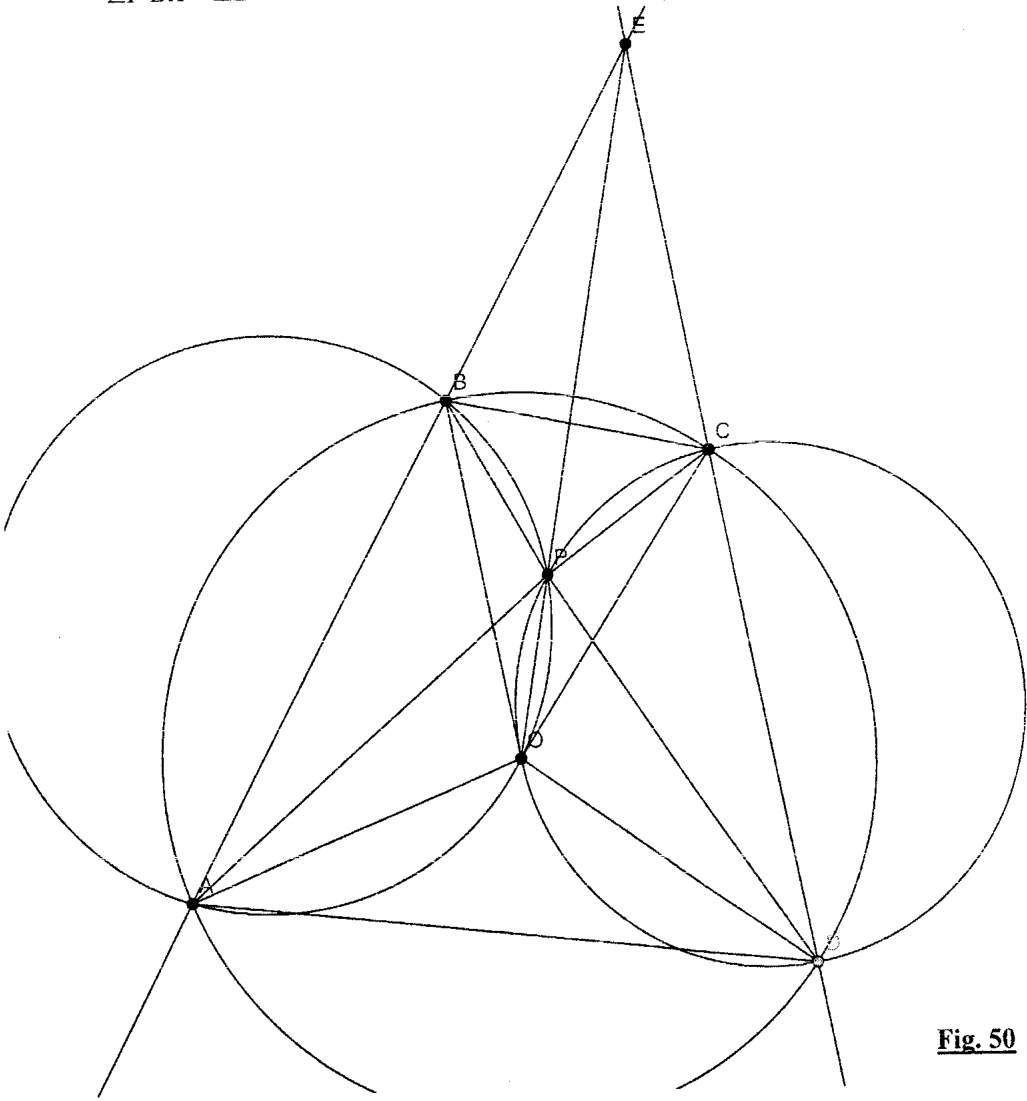
Let , be the points of intersection of the lines , and , respectively, and be the center of the circumscribed circle of the quadrilateral (Fig. 50). On the half-line we choose the point , such that . Let , , , . Then the triangles , are similar by the angle and two adjacent sides . The triangles , are also similar . Hence the points , , , lie on the same circle. Analogously, the points , , lie on the same circle since . Therefore, we have:
Similarly, . So, the points , , , lie on the same circle, and the points , , , lie on the same circle. The same is true for the point .
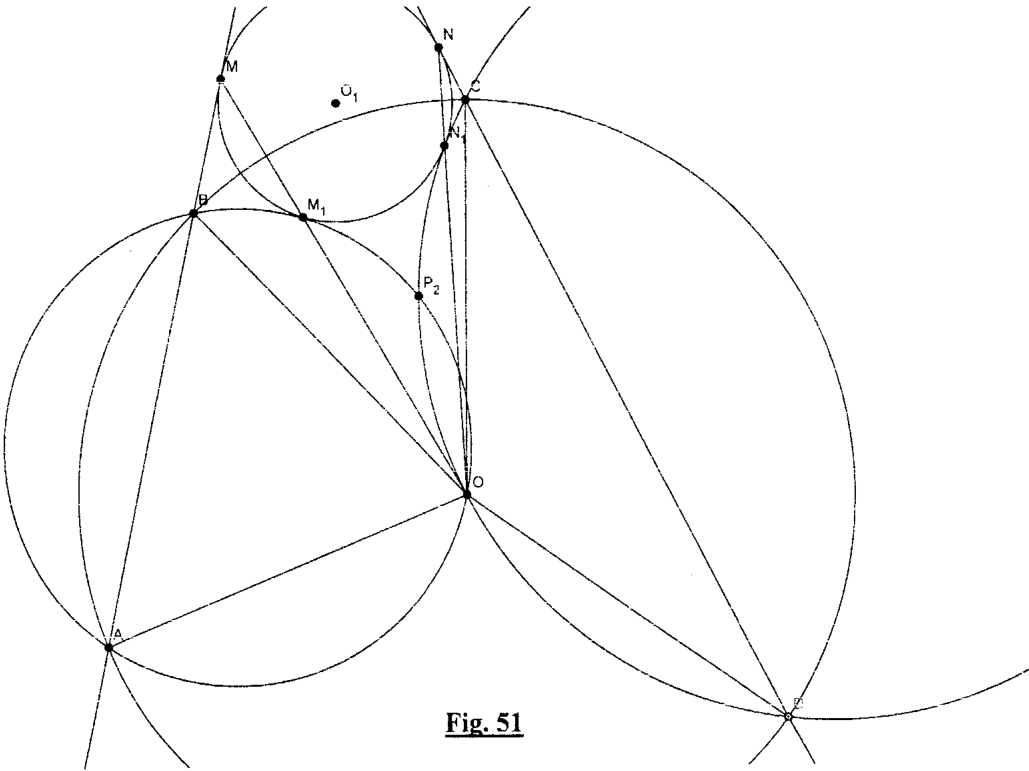
Let be the circle that touches the lines , at points , respectively and touches the circumscribed circle of the triangle at a point . By a known lemma the points , , are collinear and .
Apply the inversion with the center and radius (Fig. 51). Then the circumscribed circles of the triangles , will be mapped to the lines , respectively, the point will be mapped to the point , and so the circle will be mapped to itself.
So touches the image of the line , that is the circumscribed circle of the triangle . Thus is the circle that we were looking for.
Fig. 50
Fig. 51
Similarly, . So, the points , , , lie on the same circle, and the points , , , lie on the same circle. The same is true for the point .
Let be the circle that touches the lines , at points , respectively and touches the circumscribed circle of the triangle at a point . By a known lemma the points , , are collinear and .
Apply the inversion with the center and radius (Fig. 51). Then the circumscribed circles of the triangles , will be mapped to the lines , respectively, the point will be mapped to the point , and so the circle will be mapped to itself.
So touches the image of the line , that is the circumscribed circle of the triangle . Thus is the circle that we were looking for.
Fig. 50
Fig. 51
Techniques
Cyclic quadrilateralsTangentsInversionAngle chasing