Browse · MathNet
PrintAPMO
geometry
Problem
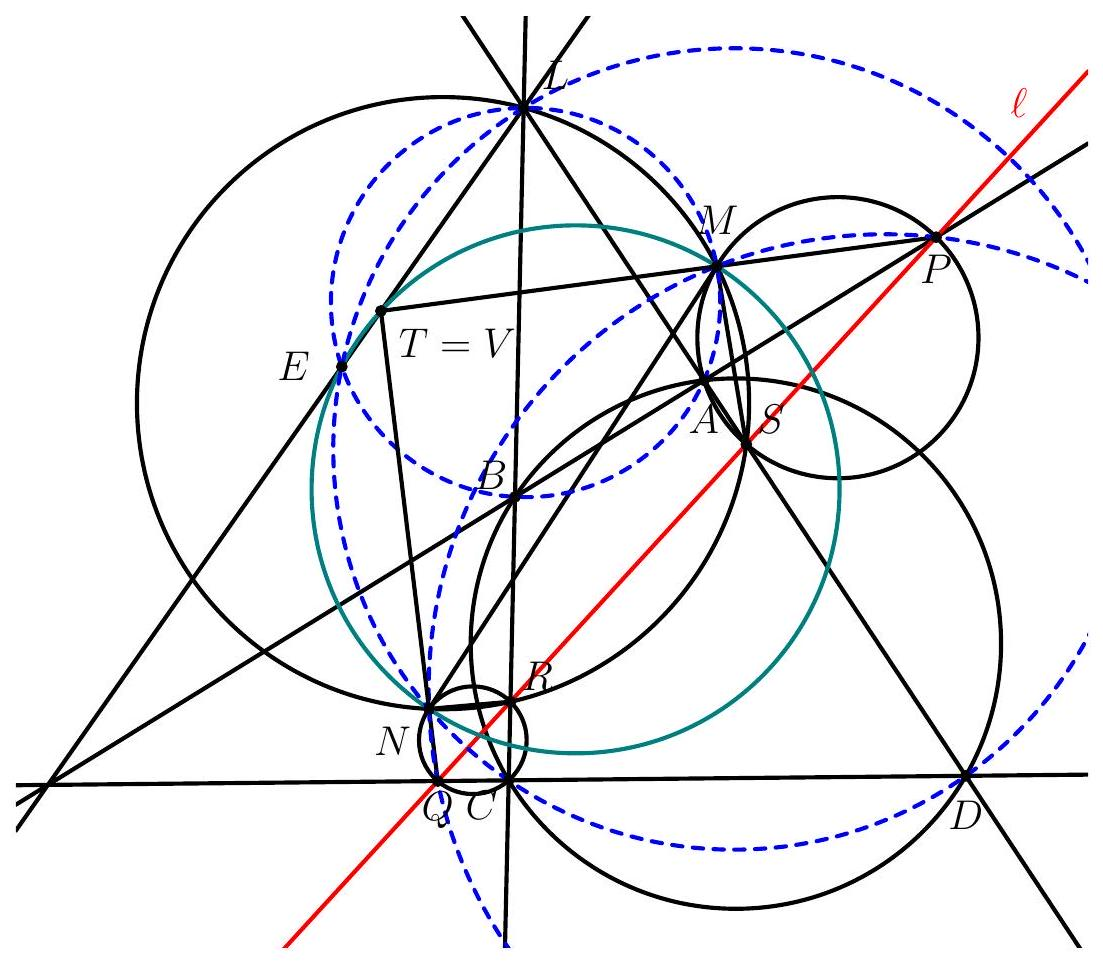
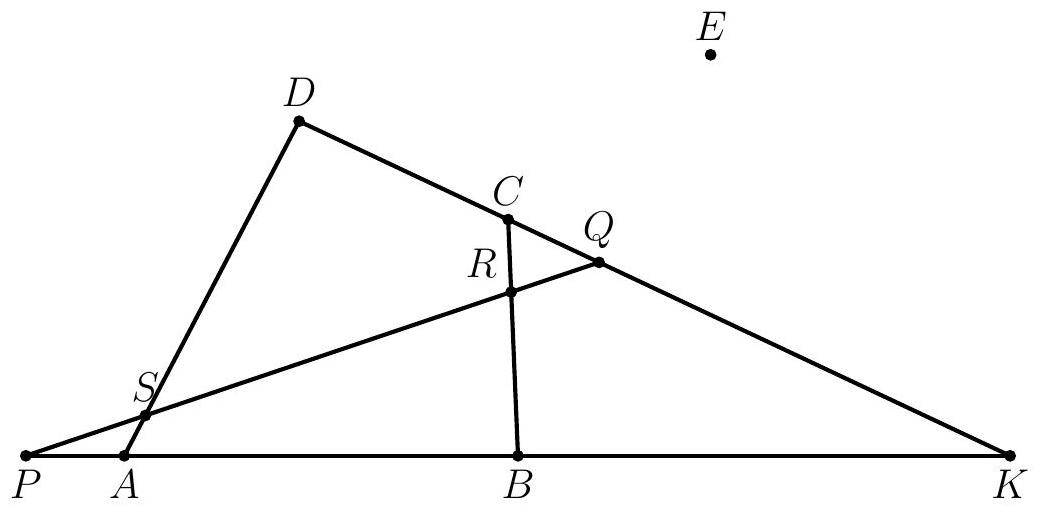
Line intersects sides and of cyclic quadrilateral in its interior points and respectively, and intersects ray beyond point at , and ray beyond point at . Circumcircles of the triangles and intersect at , while circumcircles of the triangles and intersect at . Let lines and meet at point , lines and meet at point and lines and meet at point . Prove that point lies on line .
Solution
We start with the following lemma. Lemma 1. Points are concyclic. Point is the Miquel point of lines , and , and point is the Miquel point of lines , and . Both points and are on the circumcircle of the triangle determined by the common lines , and , which is . Then, since quadrilaterals , and are all cyclic, using directed angles (modulo ) which implies that is a cyclic quadrilateral. Let be the Miquel point of (that is, of lines ). It is well known that lies in the line connecting the intersections of the opposite lines of . Let lines and meet at . If , using directed angles, looking at the circumcircles of (which contains, by definition, and ), (which also contains ), and , that is, lies in the circumcircle of . If , the same computation shows that , which means that is tangent to . Now let lines and meet at . An analogous computation shows, by looking at the circumcircles of (which contains and ), , and , that lies in as well, and that if then is tangent to . Therefore, since meet at , and , either if both and or . At any rate, the intersection of lines and lies in .
---
Alternative solution.
Barycentric coordinates are a viable way to solve the problem, but even the solution we have found had some clever computations. Here is an outline of this solution. Lemma 2. Denote by the power of point with respect to circle . Let and be circles with different centers. Considering as the reference triangle in barycentric coordinates, the radical axis of and is given by Proof: Let have the equation . Then . In particular, and, similarly, and . Finally, the radical axis is We still use the Miquel point of . Notice that the problem is equivalent to proving that lines , and are concurrent. The main idea is writing these three lines as radical axes. In fact, by definition of points , and : - is the radical axis of the circumcircles of and ; - is the radical axis of the circumcircles of and ; - is the radical axis of the circumcircles of and . Looking at these facts and the diagram, it makes sense to take triangle the reference triangle. Because of that, we do not really need to draw circles nor even points and , as all powers can be computed directly from points in lines , and . Associate with the -coordinate, with the -coordinate, and with the -coordinate. Applying the lemma, the equations of lines , and are - - - These equations simplify to - - - Now, if , and , it suffices to show that which is a straightforward computation.
---
Alternative solution.
Barycentric coordinates are a viable way to solve the problem, but even the solution we have found had some clever computations. Here is an outline of this solution. Lemma 2. Denote by the power of point with respect to circle . Let and be circles with different centers. Considering as the reference triangle in barycentric coordinates, the radical axis of and is given by Proof: Let have the equation . Then . In particular, and, similarly, and . Finally, the radical axis is We still use the Miquel point of . Notice that the problem is equivalent to proving that lines , and are concurrent. The main idea is writing these three lines as radical axes. In fact, by definition of points , and : - is the radical axis of the circumcircles of and ; - is the radical axis of the circumcircles of and ; - is the radical axis of the circumcircles of and . Looking at these facts and the diagram, it makes sense to take triangle the reference triangle. Because of that, we do not really need to draw circles nor even points and , as all powers can be computed directly from points in lines , and . Associate with the -coordinate, with the -coordinate, and with the -coordinate. Applying the lemma, the equations of lines , and are - - - These equations simplify to - - - Now, if , and , it suffices to show that which is a straightforward computation.
Techniques
Cyclic quadrilateralsRadical axis theoremMiquel pointIsogonal/isotomic conjugates, barycentric coordinatesAngle chasing