Browse · MathNet
PrintBMO 2019 Shortlist
2019 geometry
Problem
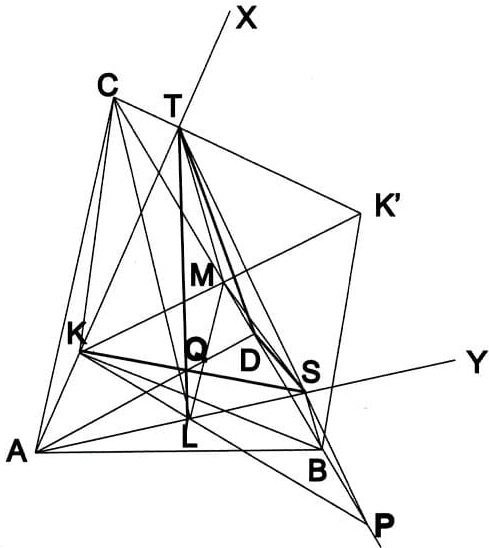
Let be an acute triangle, and , two isogonal lines. Also, suppose that , are the feet of perpendiculars from to , , and , are the feet of perpendiculars from to , respectively. Prove that and intersect on .
Solution
Denote , . Then, because the quadrilaterals and are cyclic, we have so, due to the 90-degree angles formed, we have . Thus, is cyclic. Figure 6: G6 Consider to be the midpoint of and to be the symmetric point of with respect to . Then, is a parallelogram, and so . But , because they are both perpendicular to . So, lies on and, as and is the midpoint of , . In a similar way, we have that . Thus, the center of is . Consider to be the foot of altitude from to . Then, belongs in both and . So,
and is the bisector of . Because is perpendicular to , is the external bisector of this angle, and, as , it follows that is cyclic. In a similar way, we have that is also cyclic. So, we have that , and are the radical axes of these three circles, , , . These lines are, therefore, concurrent, and we have proved the desired result. □
---
Alternative solution.
We continue after proving that is the center of . If is the foot of perpendicular from to , then is cyclic, as well as . The radical axes of those two circles and are concurrent, thus and intersect on point . So, if is the intersection point of and , due to Brokard's theorem, is perpendicular to . This is, of course, equivalent to proving that belongs on . □
and is the bisector of . Because is perpendicular to , is the external bisector of this angle, and, as , it follows that is cyclic. In a similar way, we have that is also cyclic. So, we have that , and are the radical axes of these three circles, , , . These lines are, therefore, concurrent, and we have proved the desired result. □
---
Alternative solution.
We continue after proving that is the center of . If is the foot of perpendicular from to , then is cyclic, as well as . The radical axes of those two circles and are concurrent, thus and intersect on point . So, if is the intersection point of and , due to Brokard's theorem, is perpendicular to . This is, of course, equivalent to proving that belongs on . □
Techniques
Concurrency and CollinearityRadical axis theoremCoaxal circlesCyclic quadrilateralsIsogonal/isotomic conjugates, barycentric coordinatesRotationAngle chasing