Browse · MathNet
PrintFINAL ROUND
Belarus geometry
Problem
A straight line and a point are on a plane. does not belong to the . For each point on the line a point is marked on the plane so that the triangle is equilateral (the vertices of the triangle are mentioned clockwise). Find the locus of the vertices of the equilateral triangles when the vertex moves along the line . (S. Mazanik)
Solution
If lies under the line , then the required locus is the line , where , , , , and the triangle is an equilateral triangle.
Without loss of generality suppose that lies under the line . Show that the required locus is the line , where , , , , and the triangle is an equilateral triangle.
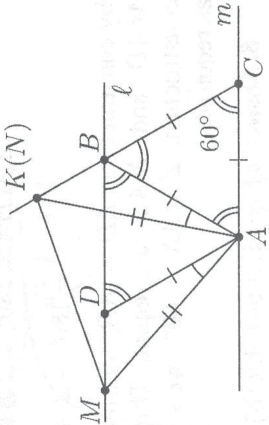
First show that all points lie on . If coincides with , then it is evident that coincides with . Let be an arbitrary point of different from . In the right half-plane with respect to the line we construct the ray with the origin at such that the angle between this ray and the line is equal to . Let be the point of intersection of this ray and the line (see the Fig.). Let be the point on the line (at the left of ) such that the triangle is equilateral. Note that
Moreover, By construction, , so from (1) and (2) it follows that the triangles and are equal. Therefore, , and since, by construction, , we see that the triangle is equilateral, i.e., coincides with , which yields .
It remains to show that for any point , there exists a point such that the triangle is an equilateral triangle.
Indeed, let . In the left half-plane with respect to the line we construct the ray with the origin at such that the angle between this ray and the line is equal to . Let be the point of intersection of this ray and the line (see the Fig.). Let be the point on the line (at the left of ) such that the triangle is equilateral. Note that
Moreover, By construction, , so from (3) and (4) it follows that the triangles and are equal. Therefore, , and since, by construction, , we see that the triangle is equilateral, as required.
Without loss of generality suppose that lies under the line . Show that the required locus is the line , where , , , , and the triangle is an equilateral triangle.
First show that all points lie on . If coincides with , then it is evident that coincides with . Let be an arbitrary point of different from . In the right half-plane with respect to the line we construct the ray with the origin at such that the angle between this ray and the line is equal to . Let be the point of intersection of this ray and the line (see the Fig.). Let be the point on the line (at the left of ) such that the triangle is equilateral. Note that
Moreover, By construction, , so from (1) and (2) it follows that the triangles and are equal. Therefore, , and since, by construction, , we see that the triangle is equilateral, i.e., coincides with , which yields .
It remains to show that for any point , there exists a point such that the triangle is an equilateral triangle.
Indeed, let . In the left half-plane with respect to the line we construct the ray with the origin at such that the angle between this ray and the line is equal to . Let be the point of intersection of this ray and the line (see the Fig.). Let be the point on the line (at the left of ) such that the triangle is equilateral. Note that
Moreover, By construction, , so from (3) and (4) it follows that the triangles and are equal. Therefore, , and since, by construction, , we see that the triangle is equilateral, as required.
Techniques
RotationConstructions and lociAngle chasing