Browse · MathNet
PrintInternational Mathematical Olympiad
geometry
Problem
Let be a triangle, and let and be two parallel lines. For , let meet the lines , , and at , , and , respectively. Suppose that the line through perpendicular to , the line through perpendicular to , and finally the line through perpendicular to , determine a non-degenerate triangle . Show that the circumcircles of and are tangent to each other.
Solution
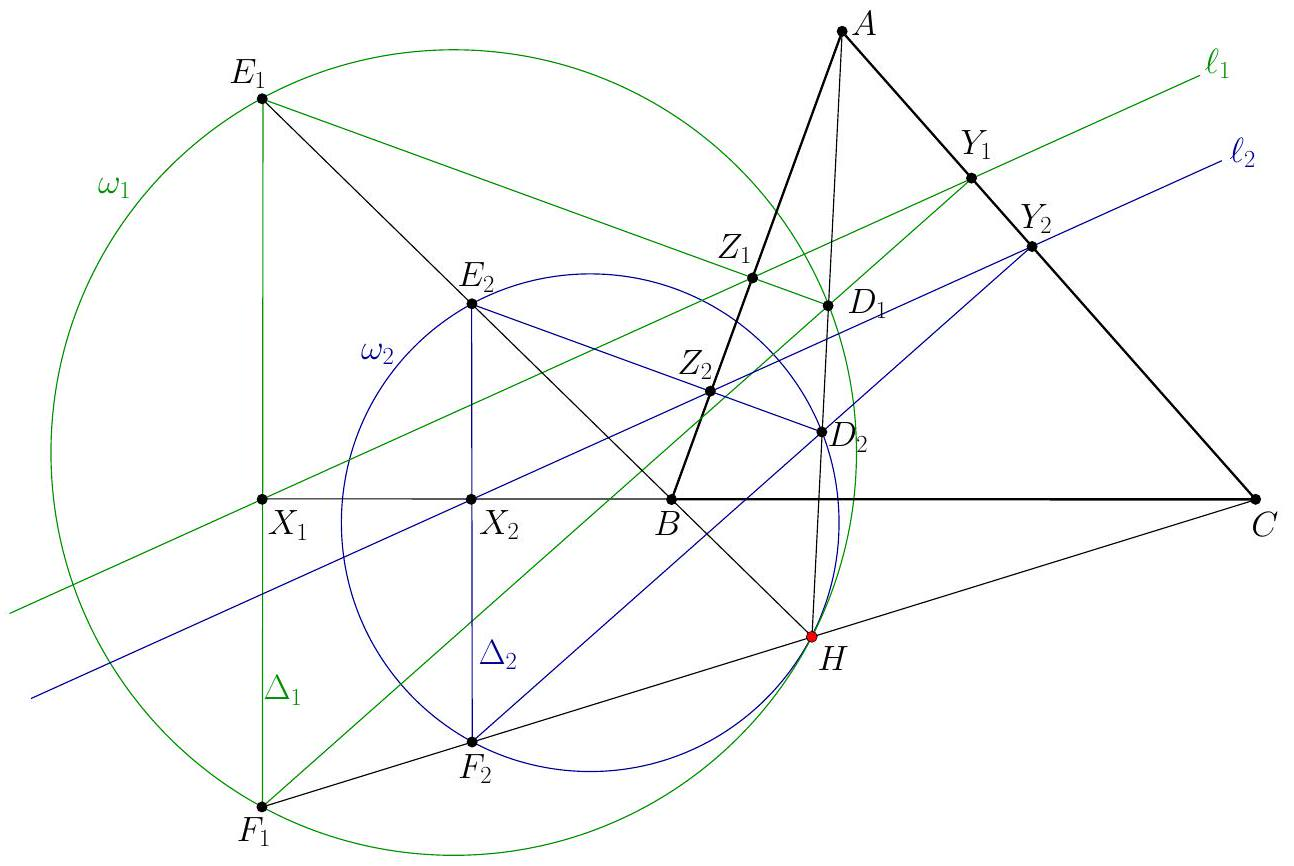
Throughout the solutions, will denote the directed angle between lines and , taken modulo . Let the vertices of be , such that lines , and are the perpendiculars through and , respectively, and denote the circumcircle of by . In triangles and we have because they are parts of and . Moreover, are perpendicular to and are perpendicular to , so the two triangles are homothetic and their homothetic centre is . Hence, line passes through . Analogously, line passes through and passes through . The corresponding sides of and are parallel, because they are perpendicular to the respective sides of triangle . Hence, and are either homothetic, or they can be translated to each other. Using that and are concyclic, and are concyclic, and we can calculate and conclude that lines and are not parallel. Hence, and are homothetic; the lines , , and are concurrent at the homothetic centre of the two triangles. Denote this homothetic centre by . For , using (1), and that and are concyclic, so lies on circle . The same homothety that maps to , sends to as well. Point , that is the centre of the homothety, is a common point of the two circles, That finishes proving that and are tangent to each other.
---
Alternative solution.
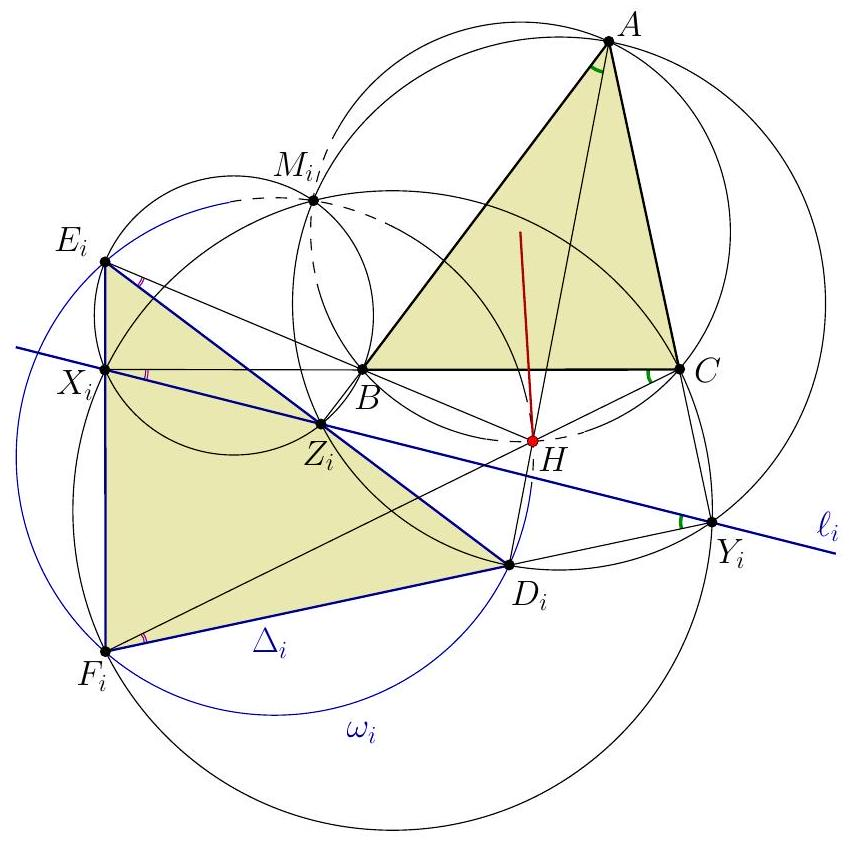
As in the first solution, let the vertices of be , such that , and are the perpendiculars through and , respectively. In the same way we conclude that and are collinear. The corresponding sides of triangles and are perpendicular to each other. Hence, there is a spiral similarity with rotation that maps to ; let be the centre of that similarity. Hence, . The circle with diameter passes through , so are concyclic; analogously () and () are concyclic. By applying Desargues' theorem to triangles and we conclude that the lines and are concurrent; let their intersection be . Since and are collinear, we obtain the same point for and . By , point lies on circle . Analogously, from , we can see that point lies on circle as well. Therefore, circles and intersect at point . The spiral similarity moves the circle to circle , so the two circles are perpendicular. Hence, both circles and are tangent to the radius of circle at .
---
Alternative solution.
As in the first solution, let the vertices of be , such that , and are the perpendiculars through and , respectively. In the same way we conclude that and are collinear. The corresponding sides of triangles and are perpendicular to each other. Hence, there is a spiral similarity with rotation that maps to ; let be the centre of that similarity. Hence, . The circle with diameter passes through , so are concyclic; analogously () and () are concyclic. By applying Desargues' theorem to triangles and we conclude that the lines and are concurrent; let their intersection be . Since and are collinear, we obtain the same point for and . By , point lies on circle . Analogously, from , we can see that point lies on circle as well. Therefore, circles and intersect at point . The spiral similarity moves the circle to circle , so the two circles are perpendicular. Hence, both circles and are tangent to the radius of circle at .
Techniques
HomothetySpiral similarityDesargues theoremAngle chasingTangentsCyclic quadrilaterals