Browse · MathNet
PrintInternational Mathematical Olympiad
geometry
Problem
In an acute-angled triangle , point is the foot of the altitude from . Let be a moving point such that the bisectors and of angles and , respectively, intersect each other on the line segment . Let and meet at , let and meet at , and let and meet at . Prove that, as varies, the line passes through a fixed point.
Solution
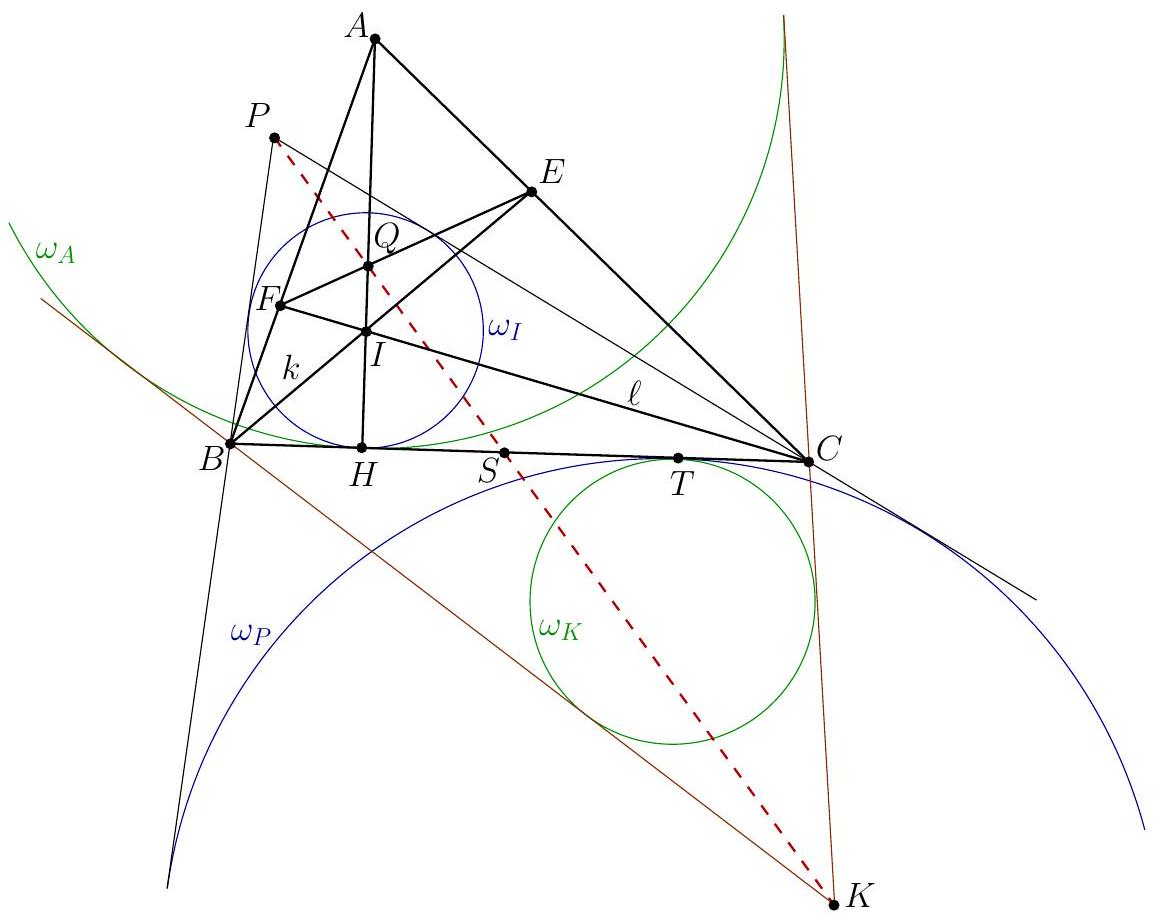
Let the reflections of the line with respect to the lines and intersect at point . We will prove that and are collinear, so is the common point of the varying line . Let lines and intersect at . For every point and , denote by () the circle centred at with radius , and define and . Let and be the incircle of triangle and the -excircle of triangle , respectively. Since and , the circles and are tangent to each other at . So, is the external homothetic centre of and . From the complete quadrangle we have , therefore is the internal homothetic centre of and . Since and are the external bisectors of angles and , circle is the -excircle in triangle . Hence, is the external homothetic centre of and . Also it is clear that is the external homothetic centre of and . Let point be the tangency point of and , and let be the tangency point of and . Since is the incircle and is the -excircle of , and since is the incircle and is the -excircle of , . Therefore and . It yields that and are tangent to each other at . Let point be the internal homothetic centre of and , and let be the internal homothetic centre of and . It's obvious that and lie on . We claim that . To prove our claim, let , and be the radii of and , respectively. It is well known that if the sides of a triangle are , its semiperimeter is , and the radii of the incircle and the -excircle are and , respectively, then . Applying this fact to triangle we get . The same fact in triangle yields . Since and , from these two we get so indeed. Finally, by applying the generalised Monge's theorem to the circles , and (with two pairs of internal and one pair of external common tangents), we can see that points , , and are collinear. Similarly one can show that and are collinear, and the result follows.
---
Alternative solution.
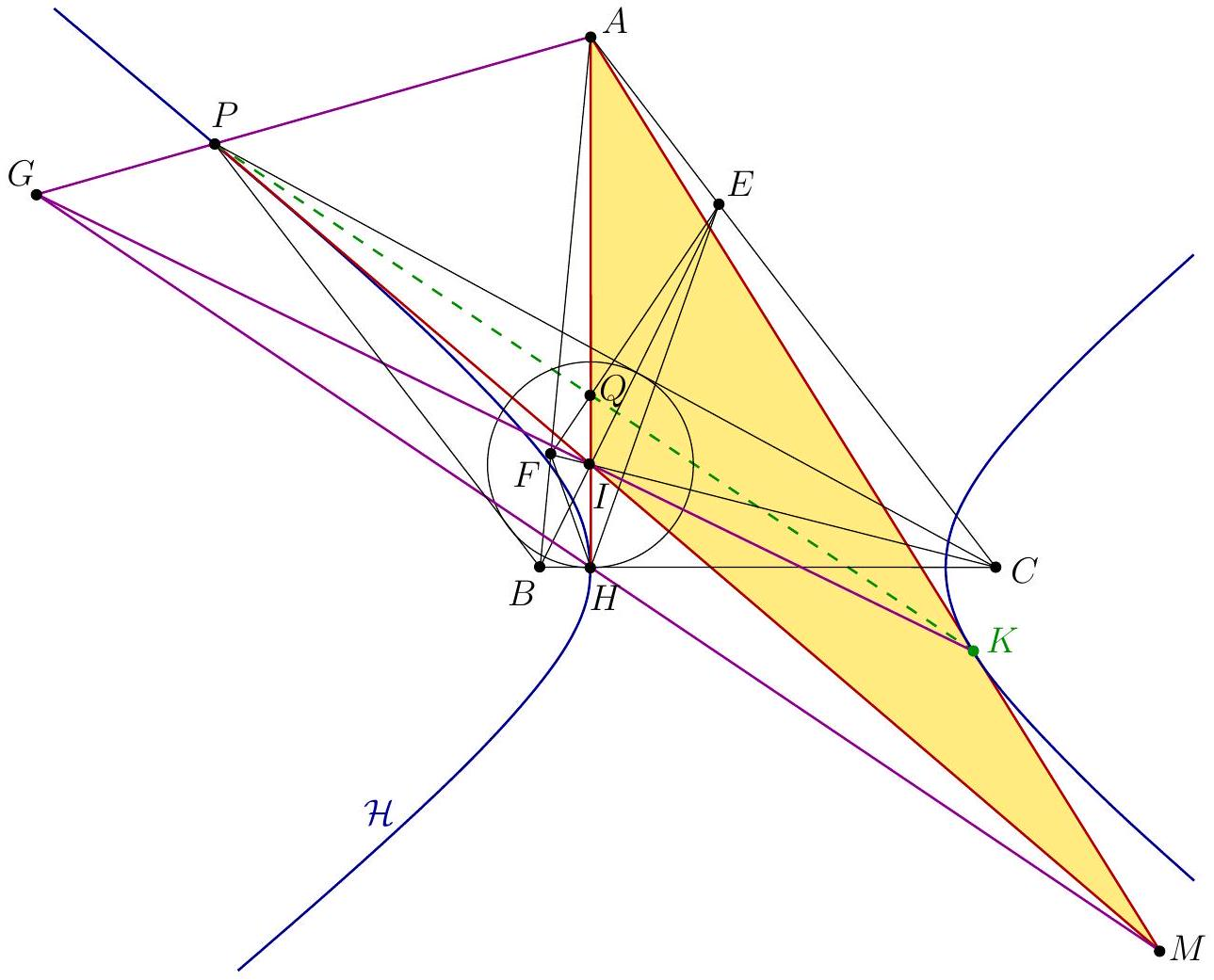
Again, let and meet at , that is the incentre in triangle ; then is the third angle bisector. From the tangent segments of the incircle we have ; hence, the possible points lie on a branch of a hyperbola with foci , and is a vertex of . Since bisects the angle between the radii and of the hyperbola, line is tangent to . Let be the second intersection of and , we will show that is tangent to at ; this property determines . Let and . From the complete quadrangle we can see that () is harmonic, so in the complete quadrangle , point lies on line . Consider triangle . Its side is tangent to at , the side is tangent to at , and is a common point of the third side and the hyperbola such that the lines , and are concurrent at the generalised Gergonne-point . It follows that the third side, is also tangent to at . (Alternatively, in the last step we can apply the converse of Brianchon's theorem to the degenerate hexagon . By the theorem there is a conic section such that lines and are tangent to at and , respectively. But the three points and , together with the tangents at and uniquely determine , so indeed .)
---
Alternative solution.
Again, let and meet at , that is the incentre in triangle ; then is the third angle bisector. From the tangent segments of the incircle we have ; hence, the possible points lie on a branch of a hyperbola with foci , and is a vertex of . Since bisects the angle between the radii and of the hyperbola, line is tangent to . Let be the second intersection of and , we will show that is tangent to at ; this property determines . Let and . From the complete quadrangle we can see that () is harmonic, so in the complete quadrangle , point lies on line . Consider triangle . Its side is tangent to at , the side is tangent to at , and is a common point of the third side and the hyperbola such that the lines , and are concurrent at the generalised Gergonne-point . It follows that the third side, is also tangent to at . (Alternatively, in the last step we can apply the converse of Brianchon's theorem to the degenerate hexagon . By the theorem there is a conic section such that lines and are tangent to at and , respectively. But the three points and , together with the tangents at and uniquely determine , so indeed .)
Techniques
HomothetyPolar triangles, harmonic conjugatesTriangle centers: centroid, incenter, circumcenter, orthocenter, Euler line, nine-point circleTangentsConstructions and loci