Browse · MathNet
PrintIMO 2016 Shortlisted Problems
2016 geometry
Problem
Let be an integer. In the plane, there are segments given in such a way that any two segments have an intersection point in the interior, and no three segments intersect at a single point. Jeff places a snail at one of the endpoints of each of the segments and claps his hands times. Each time when he claps his hands, all the snails move along their own segments and stay at the next intersection points until the next clap. Since there are intersection points on each segment, all snails will reach the furthest intersection points from their starting points after claps.
a) Prove that if is odd then Jeff can always place the snails so that no two of them ever occupy the same intersection point.
b) Prove that if is even then there must be a moment when some two snails occupy the same intersection point no matter how Jeff places the snails.
a) Prove that if is odd then Jeff can always place the snails so that no two of them ever occupy the same intersection point.
b) Prove that if is even then there must be a moment when some two snails occupy the same intersection point no matter how Jeff places the snails.
Solution
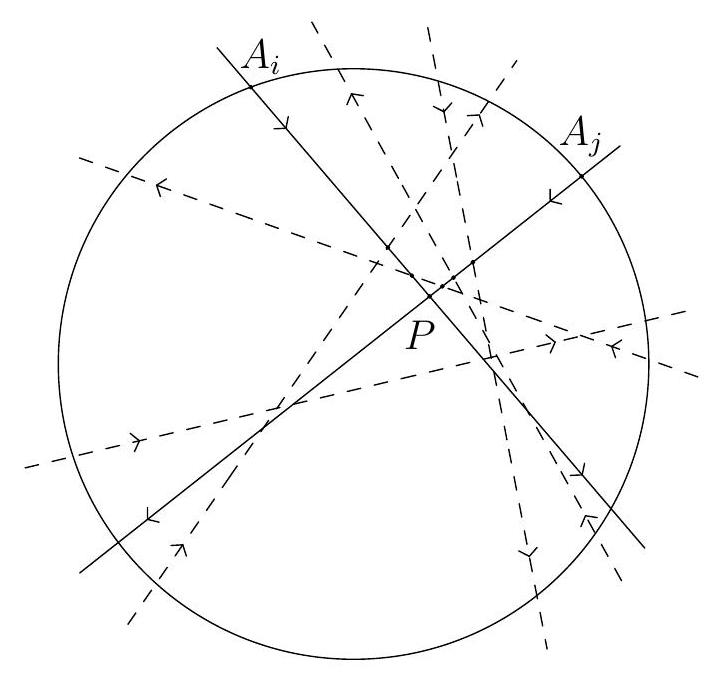
(a) For odd , we travel along the circumference of the disk and mark each of the points or 'in' and 'out' alternately. Since every pair of lines intersect in the disk, there are exactly points between and for any fixed . As is odd, this means one of and is marked 'in' and the other is marked 'out'. Then Jeff can put a snail on the endpoint of each segment which is closer to the 'in' side of the corresponding line. We claim that the snails on and do not meet for any pairs , hence proving part (a).
Without loss of generality, we may assume the snails start at and respectively. Let intersect at . Note that there is an odd number of points between . Each of these points belongs to a line . Such a line must intersect exactly one of the segments and , making an odd number of intersections. For the other lines, they may intersect both segments and , or meet none of them. Therefore, the total number of intersection points on segments and (not counting ) is odd. However, if the snails arrive at at the same time, then there should be the same number of intersections on and , which gives an even number of intersections. This is a contradiction so the snails do not meet each other.
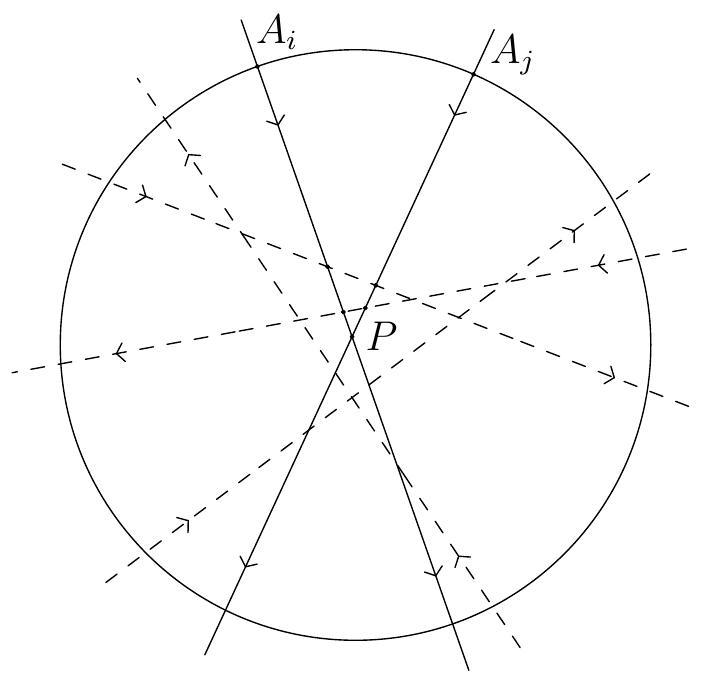
(b) For even , we consider any way that Jeff places the snails and mark each of the points or 'in' and 'out' according to the directions travelled by the snails. In this case there must be two neighbouring points and both of which are marked 'in'. Let be the intersection of the segments and . Then any other segment meeting one of the segments and must also meet the other one, and so the number of intersections on and are the same. This shows the snails starting from and will meet at .
Without loss of generality, we may assume the snails start at and respectively. Let intersect at . Note that there is an odd number of points between . Each of these points belongs to a line . Such a line must intersect exactly one of the segments and , making an odd number of intersections. For the other lines, they may intersect both segments and , or meet none of them. Therefore, the total number of intersection points on segments and (not counting ) is odd. However, if the snails arrive at at the same time, then there should be the same number of intersections on and , which gives an even number of intersections. This is a contradiction so the snails do not meet each other.
(b) For even , we consider any way that Jeff places the snails and mark each of the points or 'in' and 'out' according to the directions travelled by the snails. In this case there must be two neighbouring points and both of which are marked 'in'. Let be the intersection of the segments and . Then any other segment meeting one of the segments and must also meet the other one, and so the number of intersections on and are the same. This shows the snails starting from and will meet at .
Techniques
Constructions and lociColoring schemes, extremal argumentsPigeonhole principle