Browse · MathNet
PrintIMO 2016 Shortlisted Problems
2016 geometry
Problem
In a convex pentagon , let be a point on such that . Suppose triangles , and are similar isosceles triangles with Let be the midpoint of . Point is chosen such that is a parallelogram. Show that , and are concurrent.
Solution
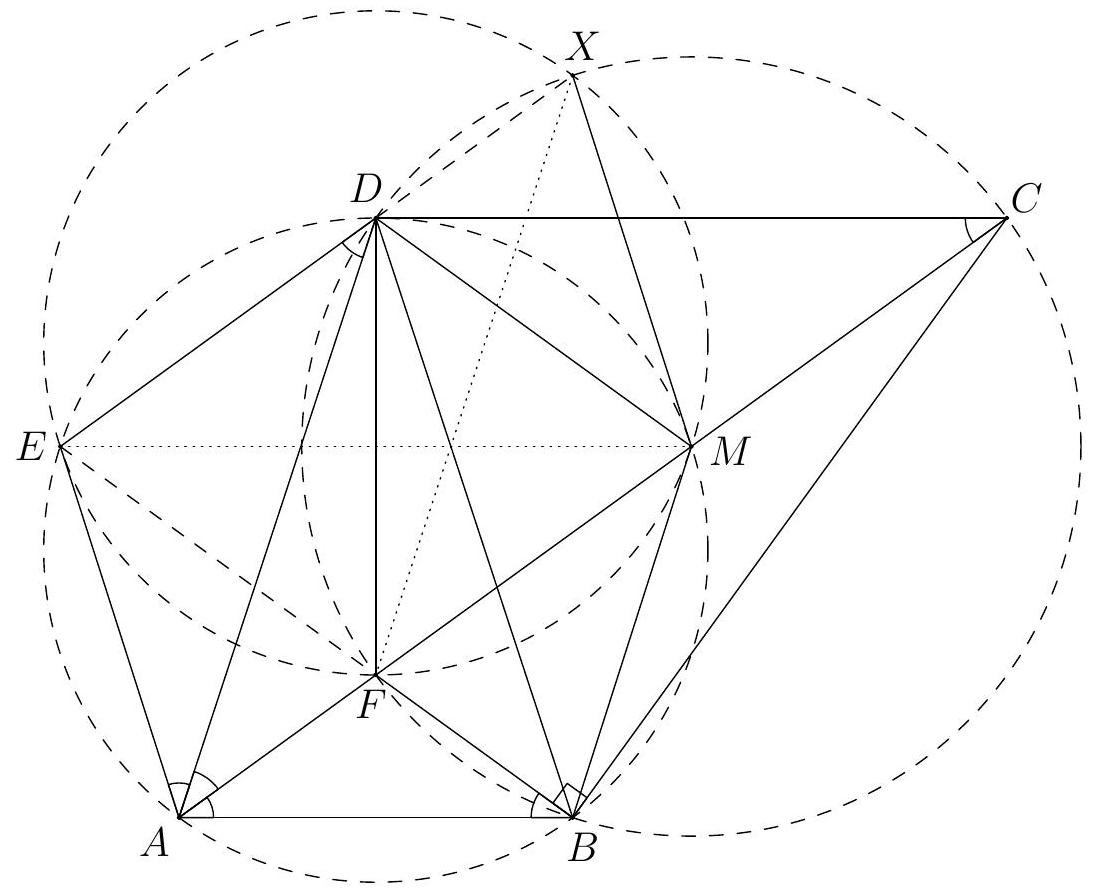
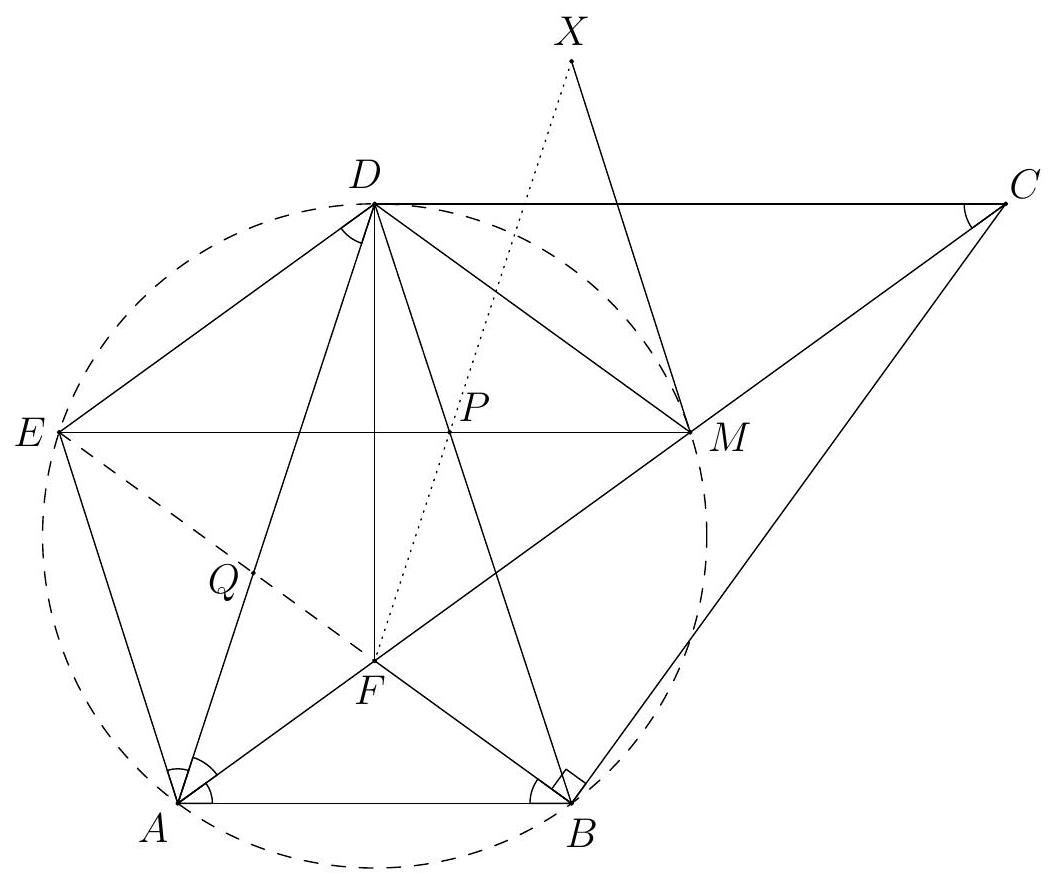
Denote the common angle in (1) by . As , we have so that . From , we get Hence, lies on the circle with centre and radius . In particular, . As , points are collinear. As , we have and hence are collinear. As is the midpoint of and , we get . In the isosceles triangles and , we have and . Therefore, they are congruent to each other. Then we have and . This shows . As and lie on and respectively and , we know that lines and are symmetric with respect to . It follows that the three lines are concurrent.
---
Alternative solution.
From , we have . Together with , we know that are collinear. Denote the common angle in (1) by . From , we get so that . This yields and hence , implying that is cyclic. Let be its circumcircle. Next, from , we have so that . Therefore, This implies are collinear. Note that is the incentre of triangle . Point lies on the internal angle bisector of and lies on the perpendicular bisector of . It follows that lies on the circumcircle of triangle , and . Also, since is a diameter of and is the midpoint of , is the centre of and hence . This shows lies on . Next, since is a parallelogram. Hence and lies on . We now have two ways to complete the solution. - Method 1. From and , is an isosceles trapezoid and is cyclic. Denote its circumcircle by . Since , , are the three radical axes of , , , they must be concurrent. - Method 2. As , we have . Also, implies . These show the corresponding sides of triangles and are parallel. By Desargues' Theorem, the two triangles are perspective and hence , , meet at a point.
---
Alternative solution.
Let the common angle in (1) be . From , we have so that . Then and hence . As , this implies is isosceles with . Then is the incentre of . Next, from , points are concyclic. Since we also have , this shows are collinear and . Note that lies on the internal angle bisector of and lies on the external angle bisector of . It follows that it is the -excentre of triangle . As is the midpoint of , lies on the circumcircle of triangle and it is the centre of the circle passing through . By symmetry, is a rhombus. Then the midpoints of , and coincide, and it follows that is a parallelogram. Let be the intersection of and , and be the intersection of and . From , we know that , , are parallel. Thus we have . This is further equal to since and . From , we find that by the Angle Bisector Theorem. This implies and hence are collinear, as desired.
---
Alternative solution.
From , we have . Together with , we know that are collinear. Denote the common angle in (1) by . From , we get so that . This yields and hence , implying that is cyclic. Let be its circumcircle. Next, from , we have so that . Therefore, This implies are collinear. Note that is the incentre of triangle . Point lies on the internal angle bisector of and lies on the perpendicular bisector of . It follows that lies on the circumcircle of triangle , and . Also, since is a diameter of and is the midpoint of , is the centre of and hence . This shows lies on . Next, since is a parallelogram. Hence and lies on . We now have two ways to complete the solution. - Method 1. From and , is an isosceles trapezoid and is cyclic. Denote its circumcircle by . Since , , are the three radical axes of , , , they must be concurrent. - Method 2. As , we have . Also, implies . These show the corresponding sides of triangles and are parallel. By Desargues' Theorem, the two triangles are perspective and hence , , meet at a point.
---
Alternative solution.
Let the common angle in (1) be . From , we have so that . Then and hence . As , this implies is isosceles with . Then is the incentre of . Next, from , points are concyclic. Since we also have , this shows are collinear and . Note that lies on the internal angle bisector of and lies on the external angle bisector of . It follows that it is the -excentre of triangle . As is the midpoint of , lies on the circumcircle of triangle and it is the centre of the circle passing through . By symmetry, is a rhombus. Then the midpoints of , and coincide, and it follows that is a parallelogram. Let be the intersection of and , and be the intersection of and . From , we know that , , are parallel. Thus we have . This is further equal to since and . From , we find that by the Angle Bisector Theorem. This implies and hence are collinear, as desired.
Techniques
Radical axis theoremDesargues theoremCyclic quadrilateralsAngle chasingTriangle centers: centroid, incenter, circumcenter, orthocenter, Euler line, nine-point circle