Browse · MathNet
Print41st Balkan Mathematical Olympiad
geometry
Problem
Let be a function from the Euclidean plane to the real numbers such that for any acute triangle with circumcenter , centroid , and orthocenter . Prove that is constant.
Solution
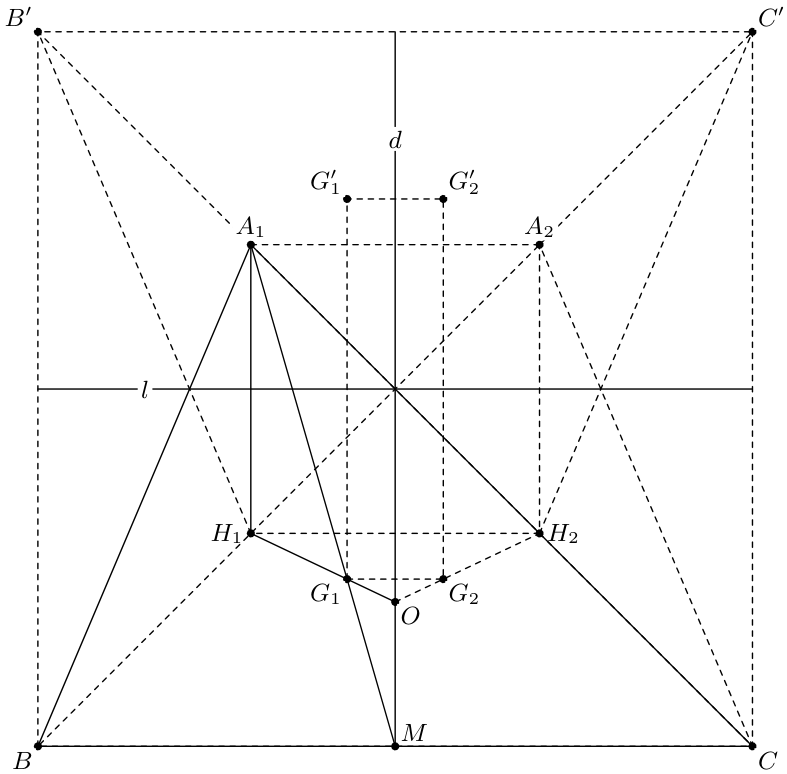
Let be arbitrary points and let be the perpendicular bisector of . We shall construct two congruent triangles, symmetric with respect to and with centroids at and . Choose an acute triangle with centroid , and rotate it around if necessary to ensure that . By applying a homotety centered at if necessary, we may ensure that the midpoint of lies on . Let be the orthocenter and circumcenter of . By construction, we have and . If are the reflections of points across , then one sees that , and are the orthocenter, centroid and cirumcenter of . Therefore, applying the property of to and , we have
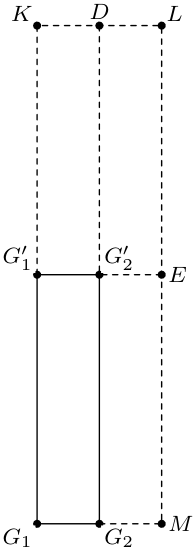
Subtracting, we obtain Now let's reflect the picture across line , the perpendicular bisector of ( is a symmetry axis of rectangle ), denoting by the image of point . It follows that , and triangles , are symmetric about . Using this symmetry, relation (1) becomes From (2) and (3) we obtain The argument up to now holds if we scale the picture. It follows that for any rectangle which is similar to the rectangle , we have Let us double up the rectangle to a rectangle (see the picture), with and the midpoints of and . Applying (4) to rectangle , we have which added to (3) yields Subtracting the last relations we get On the other hand, applying (4) to the rectangle we have The last 2 relations imply , and scaling back we finally obtain . The choice of being arbitrary, it follows that the function must be constant.
---
Alternative solution.
Alternative Solution. Assume that satisfies the condition of the problem.
1. Step 1. (Rhombus ) Consider a rhombus with . Let and lie on the diagonal such that . Then since and are equilateral we have that and are their centroids and therefore:
This proves that . As a consequence we have that whenever are collinear and then:
2. Step 2. Now consider five collinear points with . Then by Step 1 we have: Summing up both equalities we obtain: Thus whenever are collinear (in this order) with it holds:
3. Step 3. Consider a trapezoid with bases and . Let be the intersection point of the diagonals and and and be the midpoints of and . Finally let and . To start with note that by construction and therefore by Step 1: Subtracting the second equality from the first one we obtain: Now note that . Therefore and . Therefore are collinear (in this order) with and by Step 2 we have: Substituting in the above equality we obtain: Finally note that is a parallelogram () and . Clearly we can reconstruct the points and and by Thales's Theorem they will satisfy . To summarise for every parallelogram and points and with we have:
4. Step 4. Let be parallelogram and are be such that and . Applying Step 3 to the parallelogram and points and we have: Summing up we get the result from Step 3 for the original parallelogram and the points and we get: --- or whenever the line segments and the points and split and in three equal parts, respectively. We can express this result as follows. There is a function such that whenever are collinear and for , then:
5. Step 5. Let be a vector in the plane and let for . Then by Step 4 we have: Summing up both equalities we obtain: Therefore by scaling with we also have . Consequently: Therefore or, after rescaling, .
6. Step 6. Let and be the orthocenter, centroid and the centre of the circumcircle, respectively, of a triangle. Then, by Euler's Theorem, they are collinear with belonging to the line segment and . Conversely, if and satisfy the above condition, then there is an acute (isosceles) triangle such that and are the orthocenter, centroid and the centre of the circumcircle of . To see this one can take an arbitrary acute triangle with orthocenter, centroid and the centre of the circumcircle, and , respectively. Then scale so that and finally translate and rotate the diagram so that match . During this transformation, clearly, the triangle is transformed to a similar triangle .
7. Step 7. Let be collinear with . Let be arbitrary acute triangle such that are its centre of the circumcircle, centroid and orthocenter, respectively. Let be the midpoints of and , respectively. Finally, let and be the midpoints of and , respectively. We denote with the centre of the circumcircle, centroid and orthocenter, respectively, of triangle for . Note that by Step 5: Similarly we have: Summing up all three equalities and taking into account that and we conclude that:
However, obviously and a simple homothetic argument at shows that and . Therefore: Now note that is the midpoint of and similarly is the midpoint of . Since were arbitrary with , we conclude that whenever we have: Introducing to be the midpoint of and replacing with we get: Subtracting from the first equality the second one, we arrive at: Now, since by Step 2 we also have: This already shows that and therefore , implying that . Since and can be considered arbitrary, as is uniquely determined by the choice of and , we conclude that is constant
Subtracting, we obtain Now let's reflect the picture across line , the perpendicular bisector of ( is a symmetry axis of rectangle ), denoting by the image of point . It follows that , and triangles , are symmetric about . Using this symmetry, relation (1) becomes From (2) and (3) we obtain The argument up to now holds if we scale the picture. It follows that for any rectangle which is similar to the rectangle , we have Let us double up the rectangle to a rectangle (see the picture), with and the midpoints of and . Applying (4) to rectangle , we have which added to (3) yields Subtracting the last relations we get On the other hand, applying (4) to the rectangle we have The last 2 relations imply , and scaling back we finally obtain . The choice of being arbitrary, it follows that the function must be constant.
---
Alternative solution.
Alternative Solution. Assume that satisfies the condition of the problem.
1. Step 1. (Rhombus ) Consider a rhombus with . Let and lie on the diagonal such that . Then since and are equilateral we have that and are their centroids and therefore:
This proves that . As a consequence we have that whenever are collinear and then:
2. Step 2. Now consider five collinear points with . Then by Step 1 we have: Summing up both equalities we obtain: Thus whenever are collinear (in this order) with it holds:
3. Step 3. Consider a trapezoid with bases and . Let be the intersection point of the diagonals and and and be the midpoints of and . Finally let and . To start with note that by construction and therefore by Step 1: Subtracting the second equality from the first one we obtain: Now note that . Therefore and . Therefore are collinear (in this order) with and by Step 2 we have: Substituting in the above equality we obtain: Finally note that is a parallelogram () and . Clearly we can reconstruct the points and and by Thales's Theorem they will satisfy . To summarise for every parallelogram and points and with we have:
4. Step 4. Let be parallelogram and are be such that and . Applying Step 3 to the parallelogram and points and we have: Summing up we get the result from Step 3 for the original parallelogram and the points and we get: --- or whenever the line segments and the points and split and in three equal parts, respectively. We can express this result as follows. There is a function such that whenever are collinear and for , then:
5. Step 5. Let be a vector in the plane and let for . Then by Step 4 we have: Summing up both equalities we obtain: Therefore by scaling with we also have . Consequently: Therefore or, after rescaling, .
6. Step 6. Let and be the orthocenter, centroid and the centre of the circumcircle, respectively, of a triangle. Then, by Euler's Theorem, they are collinear with belonging to the line segment and . Conversely, if and satisfy the above condition, then there is an acute (isosceles) triangle such that and are the orthocenter, centroid and the centre of the circumcircle of . To see this one can take an arbitrary acute triangle with orthocenter, centroid and the centre of the circumcircle, and , respectively. Then scale so that and finally translate and rotate the diagram so that match . During this transformation, clearly, the triangle is transformed to a similar triangle .
7. Step 7. Let be collinear with . Let be arbitrary acute triangle such that are its centre of the circumcircle, centroid and orthocenter, respectively. Let be the midpoints of and , respectively. Finally, let and be the midpoints of and , respectively. We denote with the centre of the circumcircle, centroid and orthocenter, respectively, of triangle for . Note that by Step 5: Similarly we have: Summing up all three equalities and taking into account that and we conclude that:
However, obviously and a simple homothetic argument at shows that and . Therefore: Now note that is the midpoint of and similarly is the midpoint of . Since were arbitrary with , we conclude that whenever we have: Introducing to be the midpoint of and replacing with we get: Subtracting from the first equality the second one, we arrive at: Now, since by Step 2 we also have: This already shows that and therefore , implying that . Since and can be considered arbitrary, as is uniquely determined by the choice of and , we conclude that is constant
Techniques
Triangle centers: centroid, incenter, circumcenter, orthocenter, Euler line, nine-point circleRotationHomothetyVectorsConstructions and loci